The Constitution of May 3rd - between constitutional tradition and an exceptional elite experiment.
The Constitution of May 3rd - between constitutional tradition and an exceptional elite experiment.
The Constitution of May 3, 1791 as the culmination of the Polish constitutional tradition, an attempt at self-reform by the elites, and an important point of reference for the history of bibliophilia and the rare book market in Poland.

The Constitution of May 3 – between constitutional tradition and an exceptional experiment of the elites
The Constitution not as a beginning, but as the maturity of the system
The Constitution of May 3, 1791 is often described as the first modern constitution of Europe,
however, in reality, it was rather the culmination of a long constitutional evolution than its beginning.
Earlier acts, such as the Warsaw Confederation Act (1573) and the Henrician Articles
together with pacta conventa, already formed the constitutional foundations of the Commonwealth and should be treated as earlier forms of a "political constitution".

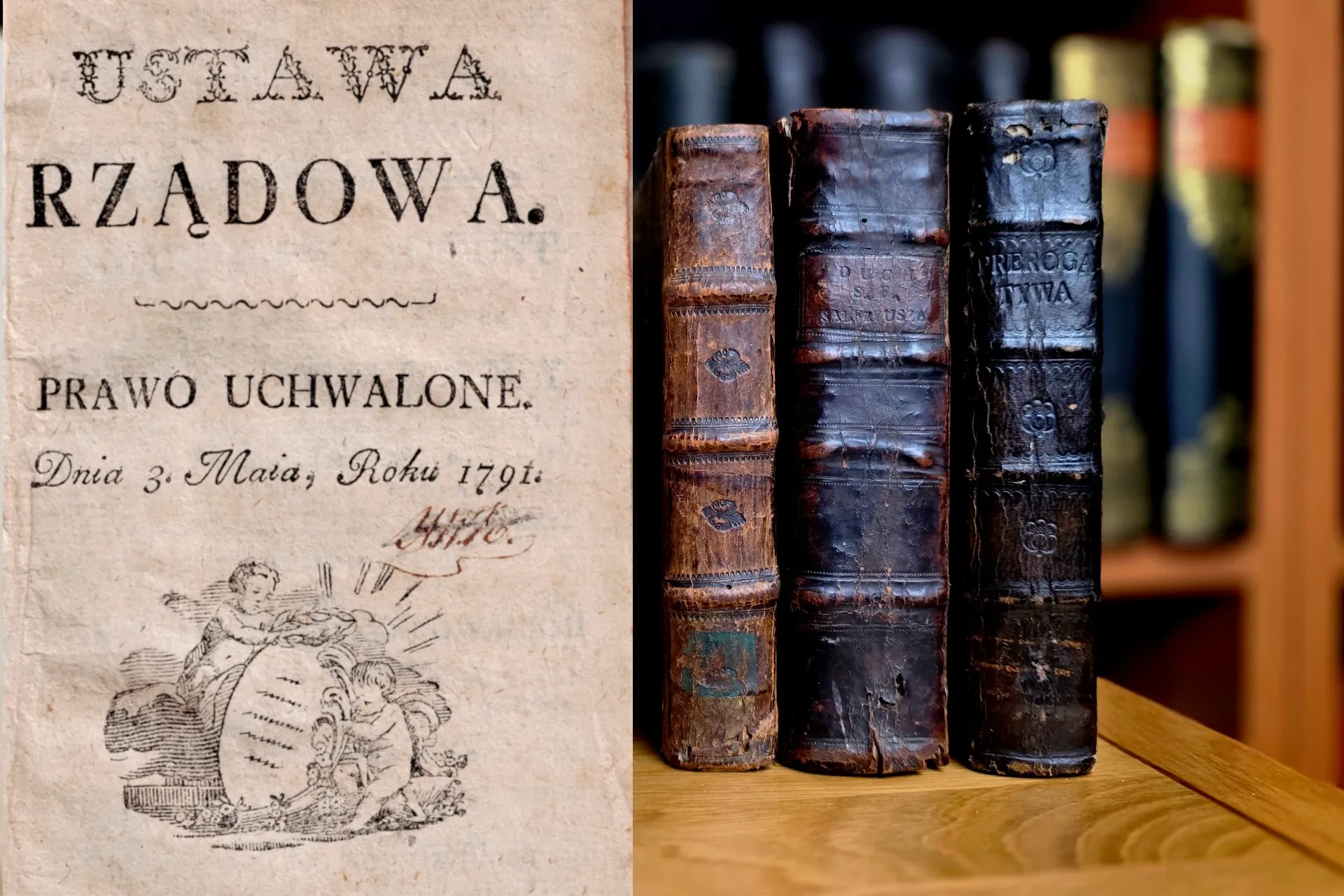
Title page of the "Government Act" (Constitution of May 3) from 1791, a print published in Warsaw by the Michał Gröll press.
Freedom and its paradoxes
The dispute over reforms concerned the fundamental question about the meaning of political freedom.
Sallust expressed this problem in the words:
„potiorque visa est periculosa libertas quieto servitio”
"Dangerous freedom seemed better than peaceful servitude"
This dilemma returned in Poland at the end of the 18th century:
does freedom without institutions lead to the collapse of the state?
Targowica and the collapse of the compromise
The response to the reform was the reaction of some elites, often being lackeys (i.e., openly paid by the partitioners), known as the Targowica Confederation.
In the name of defending old privileges, it led to external intervention and the dismemberment of the state, and consequently to the cessation of its existence.

"Block" with the first print of the Government Act - Constitution of May 3, copy with the seal and signature of Adam Skulski, i.e., its official document.
Marx and the paradox of elite reform
The greatness of the Constitution was appreciated not only by conservatives, like Edmund Burke (and Catherine II feared it).
Karl Marx also noted that the Constitution of May 3 was an exceptional case in European history:
"The Constitution indeed maintained noble privileges and did not liberate the peasants..."
At the same time, he emphasized:
"...it stands out against the backdrop of Russian-Prussian-Austrian barbarism as the only work of freedom
that Eastern Europe ever independently created... History... knows no other example of such nobility of the nobility."
Self-reform of the elite
According to researchers (including Prof. Michał Zwierzykowski), it was a reform carried out by the ruling social class – the nobility – which itself, without bloodshed, limited its own privileges.
This is the only known such case in world history.

Title page of the "Government Act" (Constitution of May 3) from 1791, a print published in Warsaw: by P. Dufour [...], [post 28 VI 1791].
The Constitution and the world of old prints
From the perspective of book culture, the Constitution of May 3 today also functions as a material and collectible object.
Editions from the period of its validity and slightly later from the existence of the First Polish Republic belong to the category of Polish old prints considered valuable.
In a broader sense, they are part of the field known as bibliophilism, i.e., the passion for collecting and studying old prints.
In this area, there is a market covering rare books, historical prints, and constitutional documents. They appear in offers of specialized places, such as specialist antiquarian old prints, as well as in sales referred to as online antiquarian.
In practice, people interested in this market segment often enter search queries like:
"where can I buy Polish old prints immediately", although the reality of this market is more complex – it includes both private collections and specialized trading houses.
On the Polish antiquarian market, there are also specialized collecting places, such as Antykwariat Sobieski, dealing with the trade of rare prints and historical materials.
Conclusion
The Constitution of May 3 remains not only a political document but also part of a broader heritage of written culture and the material history of the book.
It combines:
• the constitutional tradition of the Commonwealth,
• an attempt to modernize the state,
• and the world of bibliophilism and old prints, which to this day studies and protects the printed history of Europe.
Plaques with the immortalized text of its preamble should be at the gates of all places where lawmakers convene.
And its documents – authenticated first prints – should be treated like originals, manuscripts as NATIONAL RELICS.
Editor Wojciech Kochlewski – Młociński Bibliophile
I used a capital "M", against linguistic purists, in referring to the Constitution following Prof. Juliusz Bardach, author of the scientific introduction to the edition of the Constitution of May 3, 1791, Sejm Publishing House 2011, to give it due respect. Illustrations come from various sources.
Author's commentary
Wojciech Kochlewski and the popularization of heritage
In this context, an important role is played by Wojciech Kochlewski – bibliophile, collector, and popularizer of the heritage of the Constitution of May 3, associated with exhibition and educational activities.
More information:
https://konstytucja3maja.info
Polish old prints as an investment – readers' questions
1. What does bibliophilism mean to you?
Bibliophilism – by some, like any collecting, is considered a kind of (mental) illness.
I inherited my bibliophilism genetically. I just don't know if from an ancestor from the 17th century, who in a preserved will passed on a library to his sons, or from my grandmother, who was a stepmother (not a biological mother) to my father.
2. Why is the Constitution of May 3 so important from the perspective of bibliophilism and collecting?
The Constitution of May 3, its main part Government Act, is one of the most important acts in Polish history, appreciated by everyone worldwide who valued democracy opposing tyranny. When I realized that its first print – the official document – is almost unknown – even undervalued, I decided to counteract this.
And bibliophilism, like any collecting, significantly develops knowledge about the subject of its collecting.
3. Are the first prints of the Constitution of May 3 today considered a safe capital investment?
It depends on the "theme" of collecting, and is also conditioned by the changing political situation. For example, prices of Kresowian or "Piłsudski supporters" fell after the political change in 1990 (which is understandable). Besides, FASHION.
Prices of prints related to the Constitution of May 3 have risen greatly, much faster than other prints. However, they are still valued lower than their documents in other countries.
4. What role does educational and collecting activity of antiquarian shops play in popularizing old prints?
With good descriptions of offered items, a very large one, but errors occur even in the most well-known antiquarian shops.
5. Is an online antiquarian a safe place to buy rare historical prints?
It depends on the antiquarian. When I buy (now rarely), I have not encountered fraud. The Sobieski online antiquarian – regarding safety – I have no reservations. Only the prices – high – but maybe thanks to that such a good and extensive offer. I would like to be able to count on (big) discounts.
FAQ – Questions to the antiquarian
Is it worth collecting legal old prints?
Yes, especially when it comes to Polish legal old prints, which belong to the most valuable and stable segments of the bibliophile market.
Their importance results from their connection with the history of the constitution, law, and the development of statehood, which makes them have both scientific and collecting value.
It is crucial to use trusted sources, such as reputable antiquarian shops, auction houses, and institutional collections, where the authenticity of copies can be verified.
The condition of preservation is also of great importance, directly affecting the value – completeness, original binding, and lack of conservation interventions increase the price and prestige of the object.
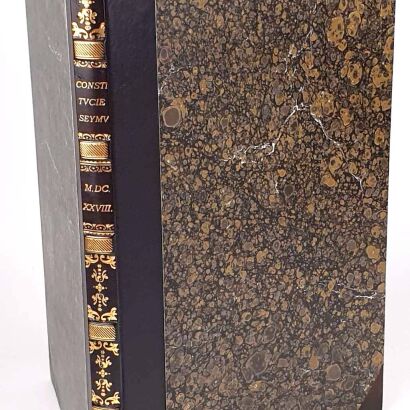
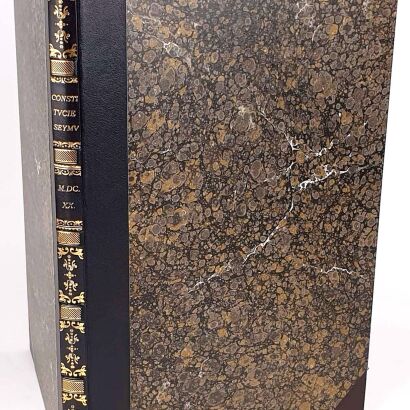
It is also worth noting that a professionally executed binding, consistent with historical craftsmanship, or expertly carried out conservation work may likewise increase the value of a print, particularly when it enhances the item’s durability and aesthetic qualities without compromising the authenticity of the copy.
Polish legal old prints are also relatively rare, which further increases their investment and collecting attractiveness.
Is the Constitution of May 3 a good investment?
Definitely yes – the Constitution of May 3 and its first prints belong to objects of high historical and collecting value.
Such prints are not produced or reproduced in a way that would increase supply, so their number on the market systematically decreases.
The most valuable copies go to private collections, archives of public institutions, and museums, where they often remain permanently.
This causes a natural "disappearance from the market" effect, which in the long term favors value growth.
From an investment perspective, it is a unique asset combining historical, cultural, and collecting value.
How to recognize an authentic Polish old print?
The authenticity of an old print is assessed based on laid paper, typography, printer's marks, and compliance with bibliographic catalogs.
In practice, the key is to compare the copy with descriptions in library and archival collections.
Transparency of the object's origin and the possibility to verify its history are crucial for purchase safety.
More in the article: How to choose an old print? Who is this guide for?
Where to buy old prints to avoid forgeries?
The safest are specialized antiquarian shops, auction houses, and verified private collections with documented provenance.
In the Polish market, a good example is Antykwariat Sobieski, which specializes in rare historical prints and old prints.
It is also worth using educational materials and guides on buying old prints, such as:
https://antyksobieski.pl/blog/jak-kupowac-starodruki-i-przedwojenne-wydania-w-internecie-kompletny-poradnik-dla-poczatkujacego-kolekcjonera
![[KONSTYTUCJA 3 MAJA 1791]. KALENDARZYK NARODOWY I OBCY Warszawa 1791/2, suplement](/media/products/8e9c43dab46a5ee2d3b24b22effbffd6/images/thumbnail/small_batch-20250625-120708.jpg?lm=1765540476)
![[WYBITNA POLSKA OPRAWA RENESANSOWA MISTRZA PORTRETÓW MEDALIERSKICH Z POZNANIA] NICEPHORI CALLISTI XANTHOPULI - SCRIPTORIS VERE CATHOLICI 1553](/media/products/2e1a46a4ab7f3b37b1ca2e5bdf86be0c/images/thumbnail/small_batch-20230512-141958.jpg?lm=1765538814)


![OSTROWSKI- PRAWO CYWILNE NARODU POLSKIEGO t.1-2 [koplet w 2 wol.] wyd. 1784](/media/products/ececfd91e31adbb97f8643911c0e12a5/images/thumbnail/small_batch-20221014-113232.jpg?lm=1765540515)




![[PRELUDIUM WOJNY ZE SZWECJĄ] UCHWAŁA SEYMU TORUNSKIEGO 1626](/media/products/a080d58b1c59ba7b90a7f9357031edc6/images/thumbnail/small_Abatch-20251021-105906.jpg?lm=1765538197)


![[Outstanding Polish Renaissance setting by the Master of Medallion Portraits from Poznan] Nicephori Callisti Xanthopuli - Scriptoris Vere Catholici 1553](/uploads/blog/main/thumbnail/thumb_6554ad16263bc-big-batch-20230515-142811.jpg?lm=1765538149)
 Polish