[Outstanding Polish Renaissance setting by the Master of Medallion Portraits from Poznan] Nicephori Callisti Xanthopuli - Scriptoris Vere Catholici 1553

[Outstanding Polish Renaissance setting by the Master of Medallion Portraits from Poznan] Nicephori Callisti Xanthopuli - Scriptoris Vere Catholici 1553
"The best of the best" section, i.e. creme de la creme, "The best of the best" not only from our offer, but the best on the market. Extremely rare things, valuable and sought-after prints, real white ravens.
Most often, these books do not appear on our website and are not available to the general public, but only to carefully selected and wealthy clients.
Due to the fact that we have been operating on the antique market for many years, we have extensive experience in acquiring valuable objects. We will help you obtain the most sought-after works in Poland.
Today, the old print is foreign, and at the same time due to its unique Renaissance binding: polonicum.
NICEPHORI CALLISTI XANTHOPULI [1256-1335]
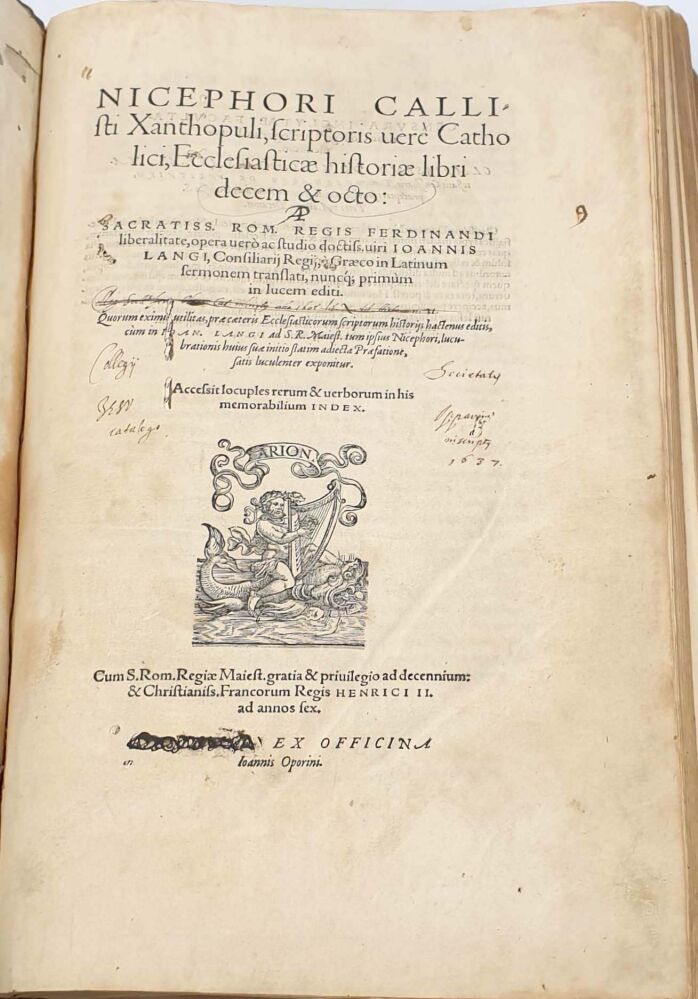
SCRIPTORIS VERE CATHOLICI, ECCLESIASTICAE HISTORIAE LIBRI DECEM & OCTO : . OPERA VERO AC STUDIO DOCTISS. VIRI IOANNIS LANGI, CONSILIARIJ REGIJ, E GRAECO IN LATINUM SERMONEM TRANSLATI, NUNCQUE PRIMUM IN LUCEM EDITI : ACCESSIT LOCUPLES RERUM & VERBORUM . INDEX 1553
Basileae [Bazylea] : Ex Officina Ioannis Oporini, Anno Salutis humanæ M. D. LIII. (1553 r.). Mense Martio (in the month of March), pp. 965, [26] k. nlb.; format folio: 25,5x39 cm; grubość ca 8 cm
History of the Church by Nicephorus Callistus Xanthopulus of Constantinople, the last of the Greek church historians.
His Historia Ecclesiastica, in eighteen books, begins the historical narrative up to 610. For the first four centuries the author was largely dependent on his predecessors, Eusebius, Socrates, Scholasticus, Sozomenus, Theodoret, and Evagrius, and his additions show very little critical thinking. His later work, based on documents that no longer exist, is much more valuable.
There is also a table of contents for the next five books, continuing the story until the death of Leo VI the Wise in 911, but it is doubtful whether the books were ever written. Some modern scholars believe that Nicephorus appropriated and passed on the work of an unknown 10th-century author as his own. The plan of the work is good, and despite fairy tales and superstitious absurdities, it contains important facts that would otherwise be unknown.
Very rare! The WorldCat database lists 2 libraries with this edition in the world!
Unlisted in trade!
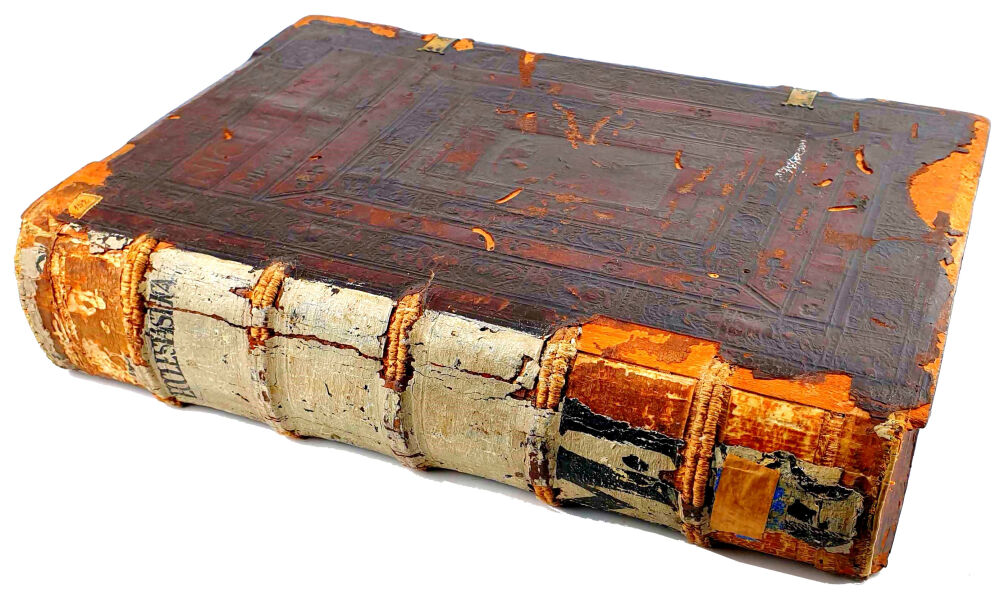
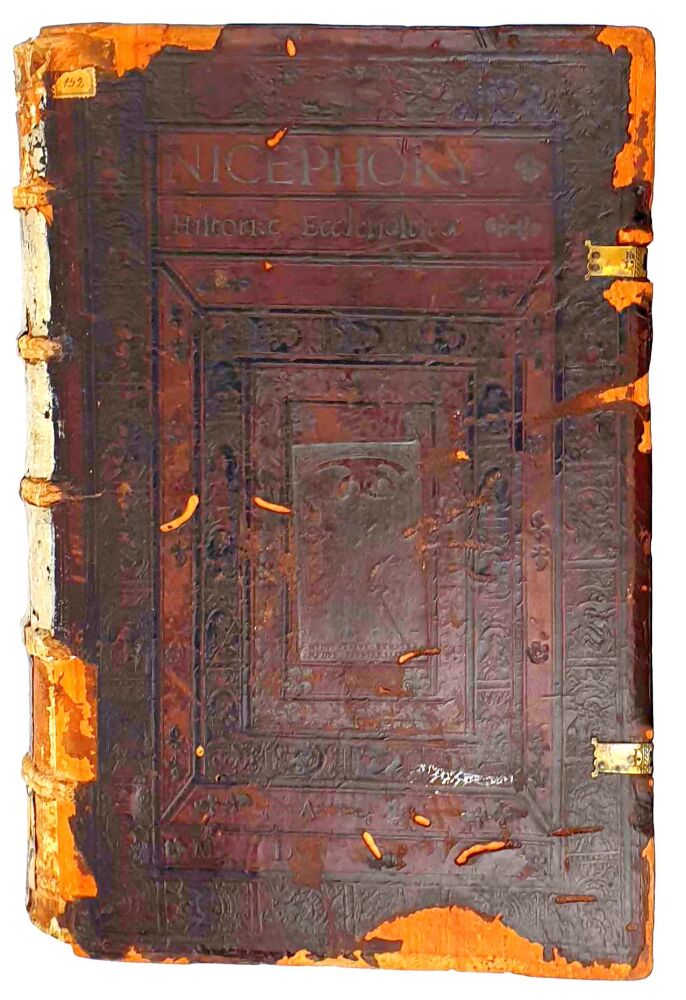
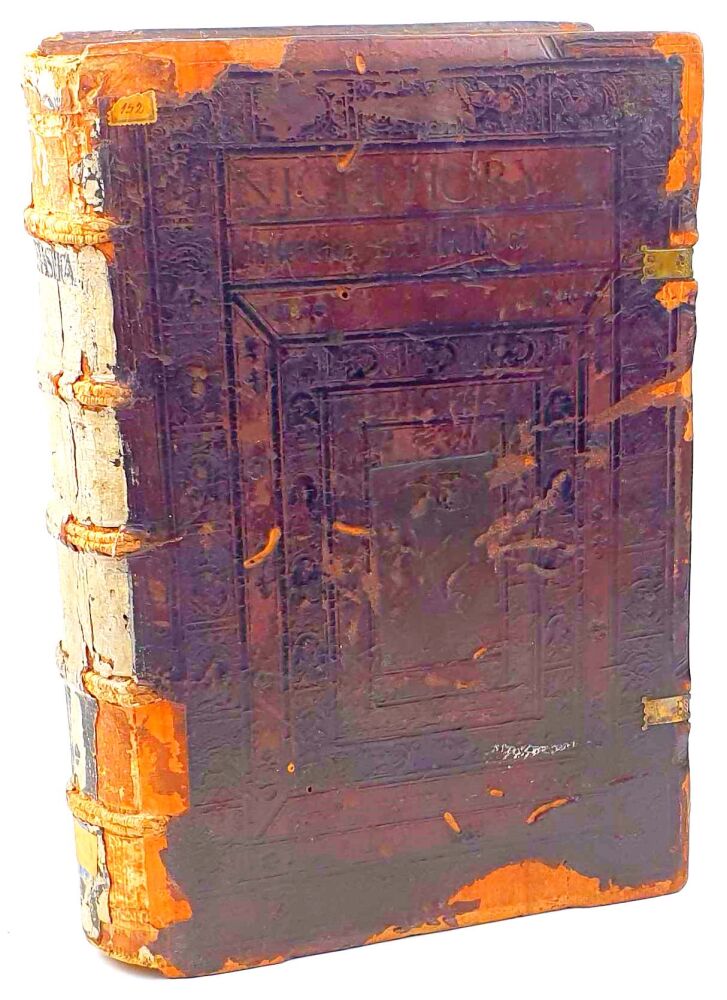
HARD BINDING, FULL LEATHER, ON A PERIOD BEECH PLANK, MADE BY A MASTER OF MEDAL PORTRAITS FROM POZNAN.
RIBBED PEPER ENDENDS WITH A WATERMARK SHOWING A HERALDIC EAGLE [PROBABLY WITH A CROWN ON HIS HEAD] ON A SIMPLIFIED CROSS ARMOR SHIELD.
THE DECORATION OF THE COVERINGS WAS MADE BY THE TECHNIQUE OF BLIND IMPRESSIONS AND THE SO-called GOLD PLATING. SZLAGGOLD [GOLD WITH A LARGE ADDITION OF SILVER], USING RURLS, PLATES, PISTONS AND A STRINGER.
THE PRECISE ATTRIBUTION OF THE ANALYZED WORK IS DECIDED BY THE RADLE SHOWING THE HALF-FIGURE OF CHRIST THE SALVATION AND THE EVANGELISTS. A DETAILED ANALYSIS OF NOT ONLY THE GENERAL FORM, BUT ALSO OF THE COMPOSITIONAL DETAILS AND EVEN THE INSCRIPTIONS DETERMINE THAT THIS IS THE WORK OF AN ANONYMOUS BOOKLIGATOR FROM POZNAŃ, REFERRED TO BY MR. ARKADIUSZ WAGNER AS THE MASTER OF MEDAL PORTRAITS FROM POZNAŃ.
"The composition of both claddings: frame with a small mirror, differing in the arrangement of knurled frames and so-called strips and the use of gilding. In the compositional center of the upper cladding (Fig. 4) there is a rectangular, gilded plaque with a figural representation in a Renaissance arcade and an inscription at the bottom "⁎ NVDVS ⁎ EXIVI ⁎ EXMATRE ⁎ || NVDVS ⁎ REVETAR [further illegible]". Above and below the plaque there are horizontal strips marked with struts, decorated with lily motifs at the ends. Together with the plaque, they are surrounded by the first, gilded knurled frame - with the so-called grotesque, containing floral motifs and masks or angel heads. Around it there is a knurled frame with half-figures of female personifications of virtues, shown under arches with arabesque and with the inscriptions below: "FIDES" (Faith), "SPES" (Hope), "CARITAS" (Love), "IVSTICIA" (Justice), "PRVDEN[tia]" (Prudence). Around it there is a frame made of slats meeting at the corners, enriched with a few motifs, pressed from pistons, the so-called Aldinian leaves and five-petal rosettes. In the upper part of the covering there are two further horizontal strips, the higher of which contains the name of the author of the print pressed from gilded capital lettering pistons ("NICEPHORY [with decorations: 3 rosettes and a lily at the end of the line]"), while the lower one contains the gilded, minuscule title of the work ("Historiæ Ecclesiasticæ [with a double Aldinian leaf at the end]"). In the lower part of the cladding, the strips contain the date of the binding: "Anno" and "M". D . L. [hereinafter illegible, probably: "V" or "X"]". The outer knurled frame shows the half-figures of Christ and the four evangelists, visible against the background of conch-shaped aedicules enriched with arabesque, and below them the inscriptions "SALVATOR", "M[a]THEVS", "MATE[by mistake(!), hereinafter:] MARCVS", "LVCAS" and "IOHANNES".
The center of the decoration of the lower covering (Fig. 5) is marked by a double, vertical knurling with half-figures of Apollo and muses visible under arches decorated with arabesque, and below the inscriptions (from the left - top): "EVTERPE", "APOLLO", "[illegible]IC[ ore]" and "CALIOPE", above and below there are short, horizontal strips, surrounded by two touching knurled frames, the first of which shows personifications of virtues (as on the cover), and the second a full set of images from Apollo with the muses: " APOLLO”, “CALIOPE”, “THALIA”, “EVTERPE” and “TERSPIC[ore]”; further there is a frame made of slats with gilded motifs of doubled Aldinian leaves and rosettes; the external knurling is marked by images of Christ and the evangelists - as on the cover.
"The above-described material, technical and decorative sphere of the work determines its recognition as a typical example of a Polish Renaissance binding in the knurling type. The following premises lead to such a conclusion: the cladding is made of beveled beech boards, the use of brown calfskin for covering and, above all, the compositional scheme decoration of the facings, in which knurls with figural representations among Renaissance ornaments were used, as well as the so-called strips with inscriptions and smaller decorative motifs. No less important is the use of a gilded, rectangular figural plaque to decorate the mirror of the upper covering, which is matched by a much more modest one on the lower facing - because blindly extruded and knurled mirror decoration.
"Compared to the above-mentioned and other identified works of the Master of Medallion Portraits, the binding offered by the Sobieski Antique Shop is distinguished by a plaque with figural decoration - not yet recorded in the literature. Moreover, lettering pistons (majuscule and minuscule) are used for the inscriptions in the strips on the upper covering. , differing in cut from those used on other works from the master's workshop. This circumstance leads to the hypothesis that the analyzed binding comes from another bookbinding shop in Poznań, which not only followed similar material and technical schemes as in the workshop of the Master of Medallion Portraits, but At least one of the same knurls was also used, among those used by the above-mentioned master...
It should be noted, however, that both the plaque, unknown in professional literature, and the unrecorded lettering pistons in the decoration of the binding offered by the Sobieski Antique Shop may not be a testimony to the activity of a previously unrecorded bookbinder, but rather an example of a particularly rare product from the workshop of the Master of Medallion Portraits. Therefore, it is probable that in the course of deepening the study of old Polish bindings, further works with similar or almost identical decorations will be identified...
In addition to the above considerations, it is worth noting the issue of the origin and time of making the watermark (filigree) on the endpaper of the print, as it influences the determination of the place and time of making the binding. A group of similar watermarks with the motif of the Eagle in the crown in a heraldic approach - both shown independently, in the field of the shield or in the coat of arms cartouche, was included by Jadwiga Siniarska-Czaplicka in the canonical catalog of filigrees of Polish paper mills from the 16th to the end of the 18th century[1]. According to the researcher's assumptions, these signs were certainly used in paper mills in the Crown, "however, their origin from a specific mill cannot be identified"[2]. At the same time, she quotes the opinion of Władysław Budka, according to which the "eagle without a crown" as the emblem of Masovia was used by a Warsaw paper mill in the years 1524-1560. A filigree that fits into the above-mentioned typology (Eagle with a crown in heraldic terms, but without a shield motif), although only from the end of the 16th century, was included by Karol Badecki in the catalog of watermarks from Lviv resources[3]. These circumstances lead us to consider the watermark from the endpaper of the print offered by Antykwariat Sobieski as a variant of Polish filigree, not yet registered in the literature, coming from an unspecified paper mill in the Crown's territory.
[1] J. Siniarska-Czaplicka, Katalog filigranów czerpalni Rzeczypospolitej zebrany z papieru druków tłoczonych w latach 1500 – 1800, Lodz 1983, s. 4, rys. 1-27.
[2] J. Siniarska-Czaplicka, s. 4.
[3] K. Badecki, Znaki wodne w księgach Archiwum Miasta Lwowa 1382 – 1600 r., Lwow 1928, tabl. XVI, il. 129.
"A detailed analysis of the material and technical aspects, and above all of the decoration of the binding, showed that it was the product of one of the leading - although still anonymous - Poznań bookbinders, operating between the 1540s and 1560s. The fact that he used, among others, a unique knurl with medallions of King Sigismund the Old and Sigismund Augustus as well as Pope Paul III, Emperor Charles V and King Ferdinand I, caused him to be described in professional literature as the Master of Medallion Portraits.
Source: Expert opinion on the time and place of the binding made by Dr. Hab. Arkadiusz Wagner, attached to the facility.
Ph.D. Arkadiusz Wagner - research and teaching employee at the Nicolaus Copernicus University in Toruń, tegumentologist specialist. Author of numerous works on medieval and early modern bookbinding in Poland and Europe, the super-bookplate as a book's ownership mark and as a work of art, the art of bookplate from the 15th to the 21st century, and book graphics from the 15th to the 21st century;
including: "Polish superexlibris. Study on bibliophilic culture and art from the Middle Ages to the mid-17th century, Wydawnictwo Naukowe UMK, Toruń 2016,
Mannerist elements in bookbinding decoration in Poland (from the 16th to the beginning of the 17th century), "Rocznik Biblioteki Narodowa", 2016, Vol. XLVII.
Good condition/binding defects visible in the photos, the spine of the binding is probably re-covered, painted white with inscriptions regarding the contents of the volume and its signature, probably in the Jesuit library in Opava; traces of an insect and discoloration of the endpapers, the paper is clean and well preserved







If you like it, give it a thumbs up:
https://www.facebook.com/antyksobieski/#

Below you will find links to the object described here, other unique Polish old prints and articles describing similar bibliophilic treasures or white ravens.
![[WYBITNA POLSKA OPRAWA RENESANSOWA MISTRZA PORTRETÓW MEDALIERSKICH Z POZNANIA] NICEPHORI CALLISTI XANTHOPULI - SCRIPTORIS VERE CATHOLICI 1553](/media/products/2e1a46a4ab7f3b37b1ca2e5bdf86be0c/images/thumbnail/small_batch-20230512-141958.jpg?lm=1765538814)


![COXE- TRAVELS INTO POLAND, RUSSIA, SWEDEN, AND DENMARK t.1-2 [komplet w 2 wol.] wyd. 1784](/media/products/4262cdc4947e971469c870cdf857bdb0/images/thumbnail/small_batch-20220527-140054.jpg?lm=1765540515)

![[Piotr Skarga - Zywoty Swiętych] Surius - De Probatis Sanctorum. T. I-VI plus Suplement (complete set) 1570, Poznan Renaissance knurled binding with images of saints, bookbinder Mc or Melchior Nering](/uploads/blog/main/thumbnail/thumb_646766598e5b2-big-batch-20230407-115941.jpg?lm=1765538151)


 Polish