[Cantional] The newly released Prussian Cantional containing a selection of old and new songs, customary in Prussia and Brandenburg.[...] Konigsberg1744
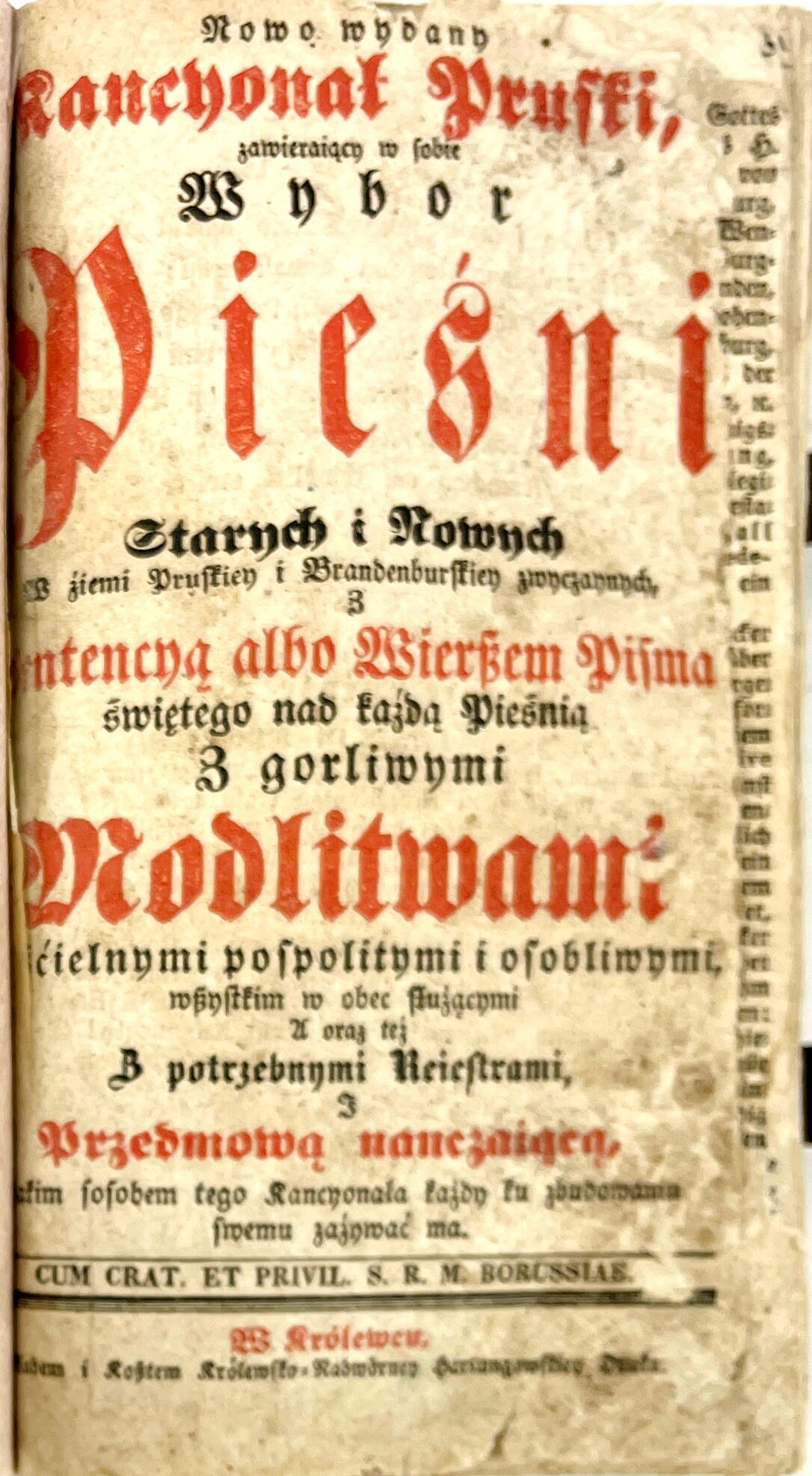
[Cantional] The newly released Prussian Cantional containing a selection of old and new songs, customary in Prussia and Brandenburg.[...] Konigsberg1744
The section "The Best of the Best", or creme de la creme, "The best of the best" not only from our offer, but the best on the market. Extremely rare items, valuable and sought-after prints, true white ravens.These books are most often not featured on our website, they are not available to the general public, but exclusively for a carefully selected and affluent clientele.
At the beginning, the privilege of Frederick William dated May 17, 1738, for Jan Hartung for the printing of Polish editions of religious texts.
"The Hartung printing house, operating from 1734 to 1871, played the greatest role in the history of Polish books in Königsberg. The printing house published, among others, the newly issued Prussian Cantional [1741] by Georg Friedrich Rogalli in the translation of Jerzy Waziański, which had 13 editions in their publishing house and played a significant role in the religious and cultural life of the Masurians" [Marian Kałuski - Königsberg in the history of Polish books and the Polish language].
"The Cantional of Włodzimierz Wasiański is a heterogeneous work, where various artistic values and epochs freely intersect. The determining factor is not the authors' confessions, as the collection includes works by Catholic poets, including Jesuits, as long as the religious content is also acceptable within Lutheranism. The principle for selecting hymns was doctrinal consistency and language criteria. In the hymn book we can find a translation of the early Christian hymn "Te Deum laudamus/We Praise You, God" (beginning with the words God! We praise You), a song with medieval origins, including a version of one of the oldest known Polish religious texts, the Easter hymn "Christ has Risen from the Dead" (Christ the Lord has risen), works and translations made by poets of the Polish Renaissance – including Mikołaj Rej, Andrzej Trzecieski, and certainly not a Lutheran, Jan Kochanowski, Old Polish hymns and translations from the 17th and 18th centuries, including numerous translations from the German language. (always with the title of the original and with a separate table of contents for the German Songs translated into the language of Polish). We are probably particularly close to the presence of Jan Kochanowski's poetic works in the cantional. The cantional includes 37 of his works, including 32 psalms from the "Psalter of David", with universal depth and beauty of language, which for centuries served the living prayer of the Masurian community. [Joanna Piotrowska - "Kancyonał pruski" from 1741, jubilee edition in the Year of Reformation in the Warmian-Masurian Voivodeship]
[E. 26, 337; E. 19, s. 89 – 90.]
'The printing of the liturgical book and the format are exactly the same as in the edition from 1741.''Sembrzycki Review p. 19 lists the edition dated 1744 as the second edition — so it will probably be the publication.' Estreicher.Very rare!Estreicher points to one library possessing this edition.
HARD COVER FULL LEATHER MODERN WITH EMBOSSING, GOLD LEAF, METAL FITTINGS AND CLASPS. COVER STYLED AFTER THE EPOCH.
Condition good/ initial leaves with minor corner losses, a leaf with privileges and another with traces of ink flooding, a copy heavily trimmed, initial leaves with minimal text edge loss, missing leaves 449-465679-682 [in their place clean leaves of ribbed paper have been inserted], several last leaves in a different order, despite some flaws THIS COPY IS WORTH ATTENTION.


 If you like it, give it a thumbs up:
https://www.facebook.com/antyksobieski/#
The offered copy will soon be available in our offer.Below you will find links to this and other exceptional Polish old prints and articles describing other rare pre-war books or white crows.
![[KANCJONAŁ] NOWO WYDANY KANCYONAŁ PRUSKI ZAWIERAJĄCY W SOBIE WYBÓR PIEŚNI STARYCH I NOWYCH, W ZIEMI PRUSKIEY I BRANDENBURSKIEY ZWYCZAJONYCH [...] Królewiec 1744](/media/products/0c96b8456844c2287a481fd3db82f49c/images/thumbnail/small_Abatch-IMG-1017-3.JPG?lm=1765540397)


![JÓZEF IGNACY Z NARZYMIA- POCZĄTEK POLSKIEGO SZCZĘŚĆIA BEZ KOŃCA PRZY KOŃCU OŚMDNIOWYCH NABOŻEŃSTWA ALBO PRZY KONLUZYI AKTU SOLENNEGO INTRODUKCYI DWUCH [!] SWIĘTYCH NOWO KANONIZOWANYCH S. STANISŁAWA KOSTKI Y SALEZEGO GONZAGI 1728](/media/products/512708497eaf9705c1c513caeeb5b2ff/images/thumbnail/small_batch-20231208-150133.jpg?lm=1765540599)




![[WYBITNA POLSKA OPRAWA RENESANSOWA MISTRZA PORTRETÓW MEDALIERSKICH Z POZNANIA] NICEPHORI CALLISTI XANTHOPULI - SCRIPTORIS VERE CATHOLICI 1553](/media/products/2e1a46a4ab7f3b37b1ca2e5bdf86be0c/images/thumbnail/small_batch-20230512-141958.jpg?lm=1765538814)
![COXE- TRAVELS INTO POLAND, RUSSIA, SWEDEN, AND DENMARK t.1-2 [komplet w 2 wol.] wyd. 1784](/media/products/4262cdc4947e971469c870cdf857bdb0/images/thumbnail/small_batch-20220527-140054.jpg?lm=1765540515)
![OSTROWSKI- PRAWO CYWILNE NARODU POLSKIEGO t.1-2 [koplet w 2 wol.] wyd. 1784](/media/products/ececfd91e31adbb97f8643911c0e12a5/images/thumbnail/small_batch-20221014-113232.jpg?lm=1765540515)

![[RENESANSOWA OPRAWA Z WIZERUNKAMI HABSBURGÓW I JAGIELLOŃCZYKÓW] NOWOPOLCZYK - APOLOGIA ALBERTI NOVICAMPIANI. Kraków 1559](/media/products/adfd8c1fe2910360016828a5d45da00e/images/thumbnail/small_batch-20250109-144014.jpg?lm=1765618191)



![[Constitutions]. Constitucie Statuta Y Przywileie Na Walnych Seymach Koronnych Od Roku Pańskiego 1550 Áż Do Roku 1637 Uchwalone. Kraków 1637. W Drukárniey Andrzeiá Piotrkowczyká](/uploads/blog/main/thumbnail/thumb_6666bf812ef20-big-batch-20240605-130121.jpg?lm=1765538148)

![[Piotr Skarga - Zywoty Swiętych] Surius - De Probatis Sanctorum. T. I-VI plus Suplement (complete set) 1570, Poznan Renaissance knurled binding with images of saints, bookbinder Mc or Melchior Nering](/uploads/blog/main/thumbnail/thumb_646766598e5b2-big-batch-20230407-115941.jpg?lm=1765538151)
![[Renaissance binding with images of the Habsburgs and Jagiellonians] Nowopolczyk - Apologia Alberti Novicampiani. Kraków 1559](/uploads/blog/main/thumbnail/thumb_67c59c3978f74-stThumbnailPlugin-2-.jpeg?lm=1765538148)
![[Outstanding Polish Renaissance setting by the Master of Medallion Portraits from Poznan] Nicephori Callisti Xanthopuli - Scriptoris Vere Catholici 1553](/uploads/blog/main/thumbnail/thumb_6554ad16263bc-big-batch-20230515-142811.jpg?lm=1765538149)
 Polish