Statute of the Grand Duchy of Lithuania from 1693. Code of law, Vilnius in the times of Jan III Sobieski and a trace of the owners from over 300 years ago.
Who issued this Statute over 300 years ago?
A unique copy of the Third Statute of the Grand Duchy of Lithuania from Vilnius from the years 1693–1694. On its pages, an extraordinary trace of history has been preserved, leading us to the year 1709.
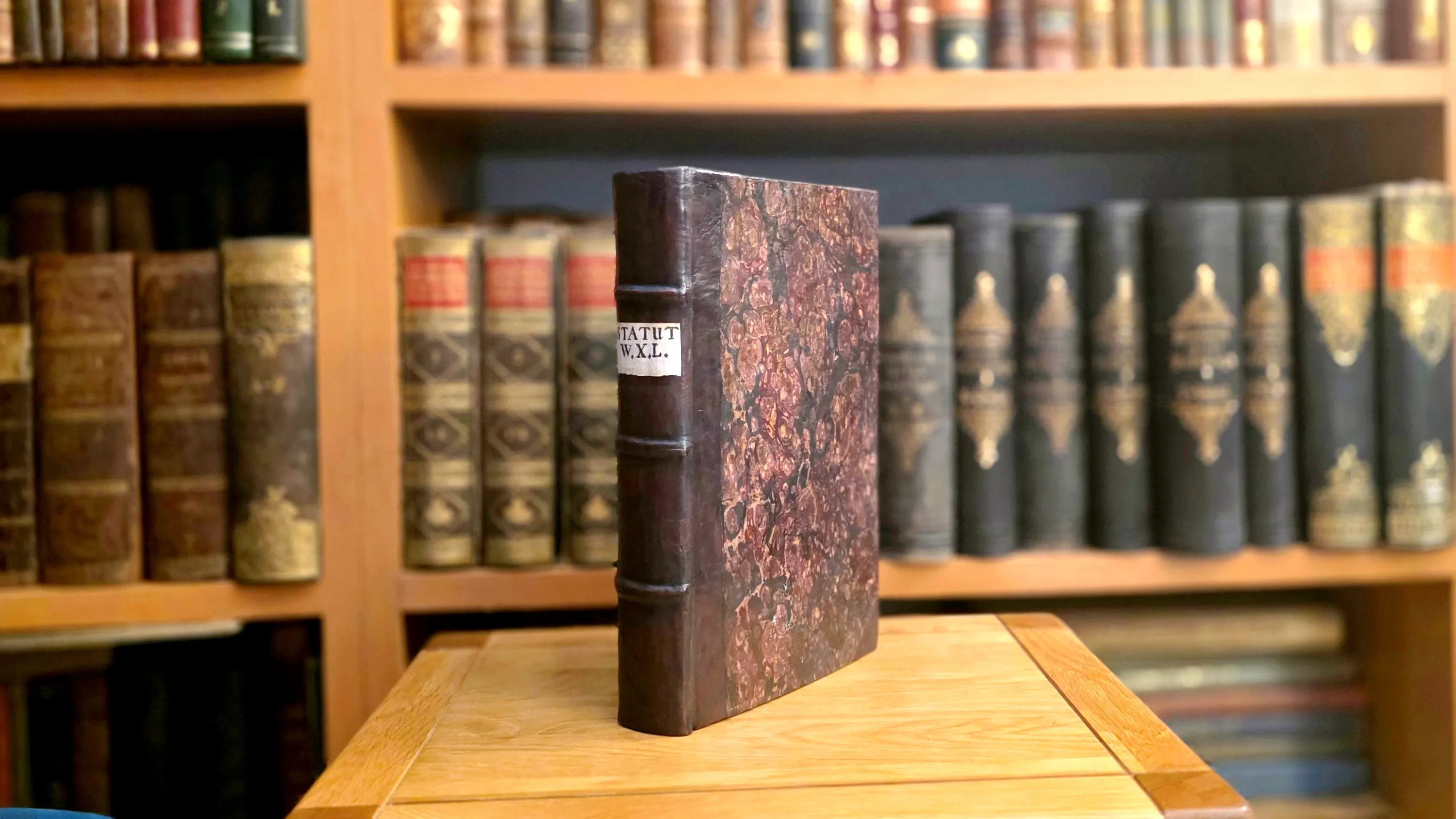
Statute of the Grand Duchy of Lithuania from 1693. Legal code, Vilnius in the times of John III Sobieski and a trace of owners from over 300 years ago
There are old prints whose significance primarily comes from their rarity. There are also those that allow a much deeper look – into the history of the state, law, culture, and the people who held them in their hands over the centuries.
The latter category includes the “Statute of the Grand Duchy of Lithuania”, published in Vilnius in the years 1693–1694 at the printing house of the Society of Jesus Academy. This is the fourth printed edition of the Third Lithuanian Statute – one of the most important legal monuments of the former Polish-Lithuanian Commonwealth.
Third Lithuanian Statute – law of the Grand Duchy
The Third Statute of the Grand Duchy of Lithuania was first promulgated in 1588, during the reign of Sigismund III Vasa. Its creation was one of the most important events in the history of the Grand Duchy of Lithuania’s legislation.
The work on the Statute’s edition was led by Lew Sapieha, the Grand Chancellor of Lithuania. A comprehensive code was created regulating almost all the most important areas of the state and its citizens’ lives – from private and inheritance law, through criminal and procedural law, to constitutional and administrative matters.
The Statute was an extension of earlier codifications of Lithuanian law from 1529 and 1566. Its significance proved exceptionally lasting. The Third Lithuanian Statute was in force on Lithuanian lands for the following centuries, until the 19th century.
Therefore, it was not merely a monument of old law. For a long time, it remained a living code, actually used by officials, judges, lawyers, and the nobility.
Vilnius, 1693–1694 – fourth edition of the Statute
The offered copy belongs to the fourth printed edition of the Third Lithuanian Statute.
After the first Kraków print from 1588, there were also Vilnius editions from 1619 and Warsaw editions from 1648. The next edition was prepared in Vilnius at the end of the 17th century, during the reign of John III Sobieski.
The printing was entrusted to the press of the Society of Jesus Academy – one of the most important printing centers of the Grand Duchy of Lithuania.
This edition had a distinctly practical character. It did not limit itself to reprinting the Statute text alone. Later Sejm constitutions from 1550 to 1690 were added to its articles, as well as references allowing comparison of individual provisions with later legislation.
For the law user, this meant the possibility of using an extensive, updated compendium of Lithuanian legislation.

Book with coats of arms of the Crown, Lithuania, and Sobieskis
A particularly interesting element of the copy is the heraldic composition placed on the back of the title page.
It features the coats of arms of the Crown and the Grand Duchy of Lithuania, as well as the Janina coat of arms associated with the Sobieski family.
This is especially expressive in the case of an edition created precisely during the reign of John III. The book documents not only the law of the Grand Duchy in force at that time but also the political and state context of the era.
“Tribunal to the Citizens of the Grand Duchy of Lithuania”
The copy is additionally interesting because, together with the Statute, a separate print was bound:
“Tribunal to the Citizens of the Grand Duchy of Lithuania at the Warsaw Sejm given in 1581”, reprinted in Warsaw in 1648.
It concerns the organization and functioning of the Lithuanian Tribunal, established in 1581 as the highest appellate court of the Grand Duchy of Lithuania.
Thus, both prints form a very logical set: on one hand, the basic legal code; on the other – regulations relating to the functioning of the most important judicial institution of the Grand Duchy.
In the margins of the “Tribunal,” handwritten references to corresponding places in the Statute and other legal acts have also been preserved. This is another trace of the actual, practical use of the book.
History recorded on the pages of the book
The most extraordinary element of this copy, however, is not the print but the manuscript entry from the early 18th century.
On one of the initial pages, a settlement act dated November 8, 1709 has been preserved. The document concerns this very copy of the Statute.
The settlement names Józef Ryniewicz and Ławrynowicz, and one of the key phrases is:
“this Statute is to be lent to Ławrynowicz”
This small sentence opens an extremely interesting window into the history of the book.
Here we do not have just a later ownership note like an “ex libris.” We have a specific document concerning the manner of using a particular copy, made only a few decades after its printing.
The book that left the Jesuit Academy press in Vilnius in 1693 already had its own legal history and users by 1709.
It is precisely such entries that make the provenance of an old print as interesting as its bibliographic description.

Book as an object of law
It is worth noting the very nature of the entry.
The Third Lithuanian Statute was a legal code – and a few decades after its publication, the copy of this code itself becomes the subject of a legal act.
This is an extremely suggestive situation.
The book describing the law of the Grand Duchy of Lithuania itself appears in a document related to its possession and use.
It is no longer an anonymous old print standing on a shelf. We can point to a specific moment in its history:
November 8, 1709.
We can name the persons associated with its further use:
Józef Ryniewicz and Ławrynowicz.
And we can read the formula preserved to this day directly referring to this book.
Three centuries of history
The further fate of the copy remains partially unknown. However, the book itself has preserved material traces of its long history.
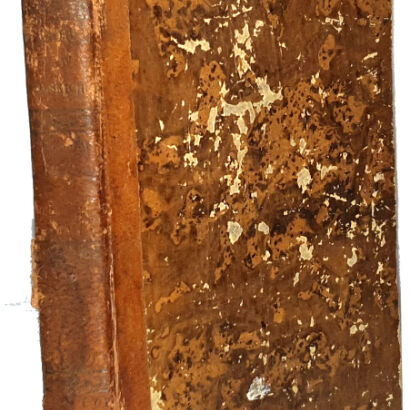
The current binding is later, 20th-century, half-leather. Some pages have been reinforced in the past, and some losses supplemented with contemporary copies. The title page and the first three unnumbered pages of the first part, as well as pages 25–30 of the second part, have survived as careful modern copies. The paper shows some stains and discolorations.
This does not, however, change the essential value of the object.
On the contrary – traces of use, marginalia, and above all the manuscript act from 1709 mean that we are dealing with a copy having its own documented biography.
Monument of the law of the former Commonwealth
The Third Lithuanian Statute is one of the most important testimonies of the legal culture of the Grand Duchy of Lithuania and the entire Polish-Lithuanian Commonwealth.
The copy from Vilnius from 1693–1694 allows us to look at this monument from several perspectives simultaneously.
It is a rare 17th-century legal print.
It is a testimony to the activity of the Jesuit Academy in Vilnius.
It was created in the era of John III Sobieski.
It contains an extensive text of the Statute along with later parliamentary legislation.
It is accompanied by a print concerning the Lithuanian Tribunal.
And above all – it has preserved an authentic trace of the history of its use from 1709.
After more than three hundred years, we can not only read the text of the law of the Grand Duchy of Lithuania. We can also see the trace of the people who owned, passed on, and used this particular book.
This is precisely what makes the old print cease to be merely a printing monument. It becomes a witness of history.
Author: Paweł Kołata
Sobieski Antiquarian
Bibliographic data
Statute of the Grand Duchy of Lithuania,
Vilnius, Printing House of the Society of Jesus Academy, 1693–1694.
Format: folio.
Statute: folios 21, pages 421, [1], 54, 10.
“Tribunal”: folio [1], pages 30.
Fourth edition of the Third Lithuanian Statute.
The copy contains two bound parts: the Statute and “Tribunal to the Citizens of the Grand Duchy of Lithuania.”
Condition: good (DB+). Later 20th-century half-leather binding; some pages reinforced, supplemented with contemporary copies, local stains and discolorations of the paper.
Special provenance element: manuscript settlement act from November 8, 1709, concerning lending this copy of the Statute, naming Józef Ryniewicz and Ławrynowicz.
![[STATUT LITEWSKI] STATUT WIELKIEGO XIĘSTWA LITEWSKIEGO Wilno 1693](/media/products/e02e7cf5737e90d5316f69d4cb4ee402/images/thumbnail/small_collage.webp?lm=1785937924)
![[STATUT LITEWSKI] PRAWA Z STATUTU W. X. LITEWSKIEGO Y KONSTYTUCYI. Warszawa 1783](/media/products/df0365d294daf33e0cbbc31e7d6c459d/images/thumbnail/small_wenet20260429-140911.jpg?lm=1777549163)





![[Constitutions]. Constitucie Statuta Y Przywileie Na Walnych Seymach Koronnych Od Roku Pańskiego 1550 Áż Do Roku 1637 Uchwalone. Kraków 1637. W Drukárniey Andrzeiá Piotrkowczyká](/uploads/blog/main/thumbnail/thumb_6666bf812ef20-big-batch-20240605-130121.jpg?lm=1765538148)
![[Piotr Skarga - Zywoty Swiętych] Surius - De Probatis Sanctorum. T. I-VI plus Suplement (complete set) 1570, Poznan Renaissance knurled binding with images of saints, bookbinder Mc or Melchior Nering](/uploads/blog/main/thumbnail/thumb_646766598e5b2-big-batch-20230407-115941.jpg?lm=1765538151)
 Polish