How to create a home library in a study style - a step-by-step guide

How to Create a Home Library in a Study Style – Step-by-Step Guide
There are libraries that develop over years, gathering books related to the owner's interests. There are also those built from the start with a specific interior in mind – as an elegant, organized book collection that gives the home study a unique character.
In both cases, books are more than just shelf furnishings. They create an atmosphere, reflect interests, and give the space an individual character.
At Antykwariat Sobieski, we have been dealing with old books, collector's editions, and multi-volume series for years, which fit perfectly in classic study libraries. We have completed many projects and helped build numerous book collections – both those based on large, decorative sets and more individual bibliophile collections.
Based on our experience, we propose a specific way of building a library: from classic literary, historical, and encyclopedic series, through carefully selected editions, to exceptional collector's copies. We know the value of individual editions, their aesthetic qualities, and the possibilities they offer when creating a coherent book collection.
This is not the only possible model. It is a proven proposal that we can adapt to individual needs, interests, available space, and budget. Many years of experience allow us to advise at every stage – from choosing the first sets to expanding the library with additional, exceptional books.
TL;DR – How to Create a Home Study Library?
-
Start with large sets of books. Classic literary, historical, and encyclopedic series allow you to quickly build a coherent, decorative book collection.
-
Choose editions with attractive bindings. Interwar series in decorative bindings look especially good and can be combined with books bound in contemporary styles.
-
Develop the library according to your interests. Literature, history, science, or art can become the foundation of an individual collection.
-
Supplement the collection with exceptional copies. First editions, rare publications, and books in artistic bindings give the library a collector's character.
-
Adapt the library to the space and budget. Not every collection has to be large or expensive.
-
Remember, there is no single correct model. The most interesting libraries arise both from conscious planning and years of passion and chance discoveries.
At Antykwariat Sobieski, we suggest starting with classic, decorative editions and then gradually expanding the collection. This is a starting point that can be tailored to individual needs and interests.
1. Where to Start? Large Series and Classic Editions
If you want to create a study library that looks coherent and elegant from the beginning, it is worth starting with larger sets of books.
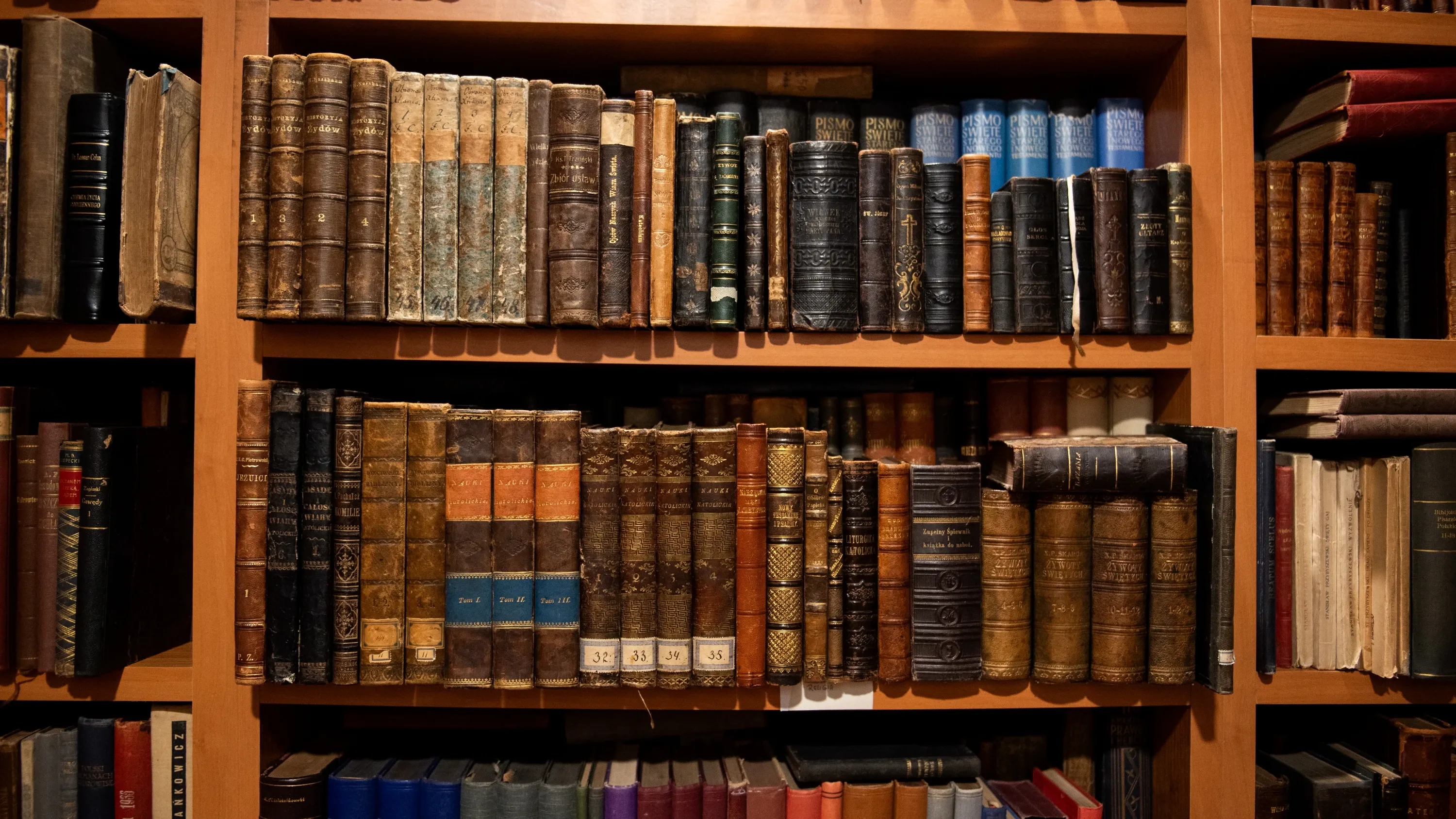
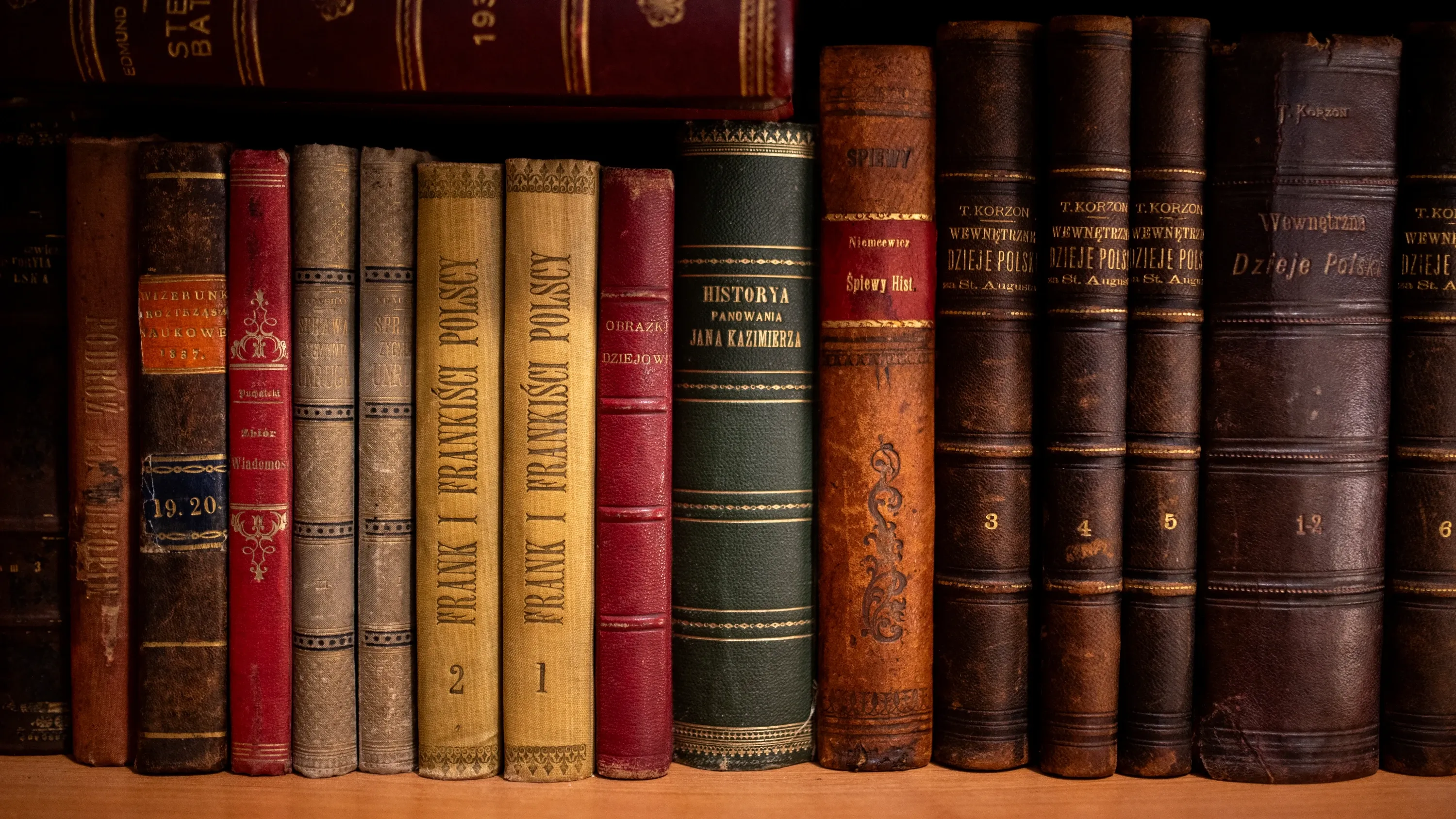
Classic historical, literary, encyclopedic, and scientific editions work particularly well. Their multi-volume nature, characteristic formats, and decorative bindings quickly give the shelves the right proportions.
Many such editions were published in the interwar period. They were often extensive series prepared with home book collections in mind. Today, their original bindings, carefully designed spines, and distinctive aesthetics make them especially attractive to those furnishing classic studies.
Among the editions often chosen for this type of library are, among others:
-
WIELKA LITERATURA POWSZECHNA, vols. I–IV (7 vols.)
-
ILLUSTRATED ENCYCLOPEDIA by Trzaska, Evert, and Michalski, vols. I–V
-
Great Illustrated Universal Encyclopedia by Gutenberg, vols. I–XX
-
POLAND – its history and culture, vols. I–III
-
WIELKA HISTORJA POWSZECHNA, vols. I–VII (11 vols.)
-
SOKOŁOWSKI – Illustrated Universal History, vols. 1–16
-
MIRACLES OF POLAND (14 volumes in original publisher bindings)
-
KARŁOWICZ, KRYŃSKI, NIEDŹWIEDZKI – Polish Language Dictionary, vols. I–VIII
-
LAM – Pantheon of Great Poets and Prose Writers, vols. I–II
-
Orgelbrand Encyclopedia (15 vols.)
-
Polish Nobility Encyclopedia, vols. I–XII
-
BRÜCKNER – Old Polish Encyclopedia, vols. I–II
-
Ultima Thule Universal Encyclopedia, vols. I–IX
-
Agricultural Encyclopedia (1890, 11 vols.) – with an extensive section on gardening and architecture
-
KNOWLEDGE ABOUT POLAND (5 vols.)
-
KOPERA – History of Painting in Poland (1929)
-
KOPERA – Polish Museums, vols. 1–5

These are examples of publications that combine substantive value with aesthetic qualities. Their presence allows you to create a library with a classic character and at the same time serves as a good starting point for further developing the collection.
It is worth paying attention to the completeness of sets, condition, and consistency of bindings. In the case of larger series, these elements significantly affect their reception.
Our offer includes many such editions. This is a proposal for those who want to start building a library from larger, coherent sets without the need to search for each book separately.
2. Decorative Bindings – Combining Tradition and Modernity
In a classic study library, the bindings of books have special significance.
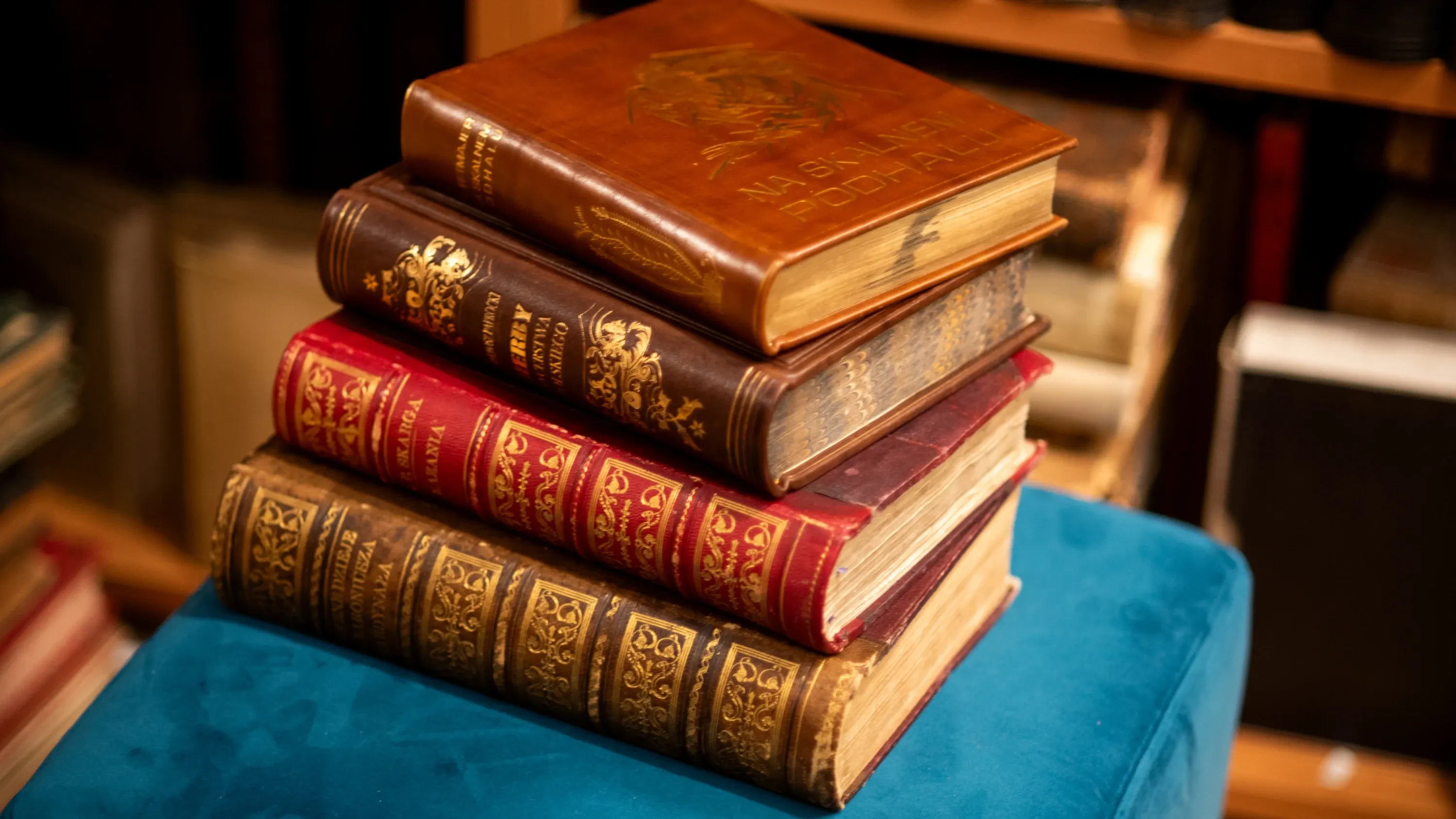
Interwar editions often stand out with decorative bindings, characteristic embossings, ornamentation, and carefully designed spines. Their aesthetics harmonize perfectly with both traditional study decor and more contemporary interiors.
An interesting effect can be achieved by combining them with books in uniform, contemporary bookbinding styles. Alongside original editions of literature, history, or encyclopedias, classic works bound in leather with hand-made decorations or individually designed spines can appear.
This way, you can create a library where old editions retain their historical character, and contemporary bindings introduce an additional element of elegance.
It is not necessary for all books in a home library to look identical. Often, an interesting effect comes from combining several aesthetics that complement each other.
However, this is not the only way. The history of bibliophilia also knows of collections where consistently applied decorative bindings became the hallmark of the entire collection. This was the case, among others, in the library of Feliks Wężyk from Mroczeń, whose books were distinguished by characteristic embossings and decorations, as well as in the collection of Zygmunt Czarnecki, where the owner's superexlibris and similar spine decorations gave the collection a coherent character.
In a home library, you can therefore opt for both harmonious diversity and consistently maintained, uniform aesthetics. Much depends, however, on the character of the collection itself. In the case of old books preserved in original bindings, we do not always have the possibility to freely shape their appearance – and it is not always worth doing so. A beautiful, historic binding is part of the book's value and should not be sacrificed solely to unify the appearance of the entire collection.
Coherence of the library can be achieved in various ways. Sometimes it is enough to arrange books on shelves appropriately, grouping them by era, subject, format, or binding style. In larger spaces, you can go a step further: designate separate parts of the library where individual collections will have their own character. One may be maintained in a uniform style, another based on old, original bindings, and yet another combining different forms and aesthetics.
Ultimately, it is the space, the character of the books, and the owner's individual preferences that decide how the library will look. It does not have to be uniform to create a thoughtful and harmonious whole.
3. Supplementing the Collection – Literature, History, and Personal Interests
Once the shelves have their foundation, it is time to further develop the collection.
This is the stage where the library begins to increasingly reflect the owner's interests. Additional literary works, historical books, scientific publications, and editions related to specific fields appear.
You can develop individual sections, supplement existing series, or look for books that have long been on the collector's wish list.
For example:
-
KORZENIOWSKI – Works (1871, 12 vols.)
-
BOBROWSKI – Latin-Polish Dictionary (Vilnius 1822)
-
KUBALA – Works (6 vols., including “The Deluge”)
Such publications allow you to give the library a more individual character. They do not have to be part of large, uniform sets. Sometimes a single book, chosen because of the owner's interests, becomes the beginning of a new section.
It is worth remembering that the collection does not have to be complete from the start. Its development can be as interesting as owning the books themselves.

4. Bibliophile Copies – Exceptional Books in an Exceptional Library
As the collection develops, there is an opportunity to introduce books of special collector's significance.
These can be first editions of important works, rare 19th-century and interwar publications, books with documented provenance, or copies distinguished by exceptional bindings.
It is these items that often become the most important elements of the library.
Their value comes not only from rarity but also from the significance of the edition, the history of the copy, its condition, and the quality of the binding.
At Antykwariat Sobieski, we have been collecting and offering such publications for years. Our stock includes both classic editions that can form the basis of a home collection and bibliophile books intended for more advanced collectors.
This makes it possible to gradually develop the library – from larger sets to individual, exceptional copies.
However, this does not mean that every library must contain rare first editions. For one owner, the most important will be a complete historical series; for another, a collection of fine literature; and for yet another, a few exceptional books in artistic bindings.
5. Library Adapted to Space and Budget
There is no universal way to build a study library.
Much depends on the available space, number of shelves, budget, and the owner's interests.
In a small study, a carefully selected set of books that does not overwhelm the interior will work better. In a larger room, you can afford extensive series, multi-volume encyclopedias, and a more diverse collection.
It is also important whether the library is primarily to serve a decorative, functional, or collector's purpose.
In practice, it is worth considering several options:
-
Classic library – based on large literary, historical, and encyclopedic series.
-
Literary library – developed around the classics of Polish and world literature.
-
Historical library – focused on the history of Poland, Europe, and the world.
-
Collector's library – created around first editions, rare publications, and exceptional bindings.
-
Mixed library – combining large series, literature, scientific books, and individual bibliophile copies.
Each of these models can be equally interesting. The most important thing is that it meets the owner's needs and the possibilities of the space.
6. Not Every Library Is Created According to a Plan
Although conscious building of a collection allows achieving a coherent and elegant effect, it should not be forgotten that many exceptional libraries were created quite differently.
Sometimes the beginning of a collection is a book bought by chance, which over time leads to further discoveries. Other times, the library develops around one author, a specific field, or a family collection passed down through generations.
A good example is historic Polish collections. The Kórnik Library developed over generations thanks to the activities of the Działyński family and later Władysław Zamoyski. The Ossolineum collections grew from the collections of Józef Maksymilian Ossoliński and Henryk Lubomirski, gradually enriched by further donations and acquisitions. Meanwhile, the Krasinski Ordination Library gathered books from various private collections. Their histories show that great collections do not always arise according to a single, predetermined plan.
Similarly, a home library can develop. Someone starts with a few volumes of old Polish literature and gradually becomes interested in further editions, the history of printing, or exceptional bindings. Another begins with maps, old atlases, or books related to the history of their hometown. It also happens that the starting point is a collection inherited from relatives, which is gradually supplemented with new acquisitions and gains an individual character.
In such cases, it is not a ready-made project that determines the library's appearance but the history of its creation, the owner's interests, and the subsequent books that come into it.
Therefore, our proposal is not the only way. It can serve as inspiration for those just starting to build a collection, but we are equally happy to help develop existing collections – selecting additional editions, rare copies, and books that enrich their character.
7. A Library That Matures
The best libraries do not have to be closed projects.
They develop along with the owner, his interests change, new discoveries appear, and more books arrive.
Sometimes it all starts with a large set of encyclopedias. Sometimes with a few volumes of literary classics. Other times with a single copy that becomes the beginning of a long-lasting passion.
Over time, subsequent editions, bindings, and collector's books create a whole that cannot be reproduced according to a ready-made scheme.
That is why every library is different.
8. Collector's Guide – Knowledge in Practice
Building a valuable collection requires not only aesthetic sensitivity but also knowledge about books.
It is worth knowing how to recognize editions, assess condition, distinguish publisher bindings from bookbinder bindings, and determine the collector's value of individual copies.
An extension of these topics is our educational series:
Collector's Guide to Old Books and Incunabula
This is a place where we discuss practical aspects of building collections – from assessing the value of books, through recognizing editions, to issues of bindings and printing history.
For both those starting their adventure with collecting and those who want to consciously develop their libraries.
Conclusion
A home study library can be created in many ways.
It can be the result of a conscious choice of large, decorative series, then expanded with further editions and exceptional copies. It can also develop over years as a result of personal interests, chance discoveries, and collecting passion.
At Antykwariat Sobieski, we suggest starting with classic editions that allow creating a coherent and elegant foundation for the collection. Then we help develop it according to interests, possibilities, and the individual character of the collection.
More about our private library and home collection creation service can be found in the article: Private Libraries and Creating Home Collections.
A well-built library is not just books on shelves.
It is a space that over time becomes part of its owner's history.
FAQ – Frequently Asked Questions
Where to start building a home study library?
A good starting point is larger, multi-volume literary, historical, and encyclopedic series. They allow creating a coherent foundation for the collection and then gradually supplementing it with books matching the owner's interests.
Which books look best in a study library?
Classic editions in decorative bindings, multi-volume encyclopedias, literary series, and books in bookbinder bindings work particularly well. It is worth combining different eras and styles while maintaining appropriate proportions.
Is it worth buying entire series of books for a home library?
Yes. Complete series quickly give shelves a coherent character. However, completeness, condition, binding consistency, and whether the edition matches the owner's interests are important.
Does a home library have to consist of old books?
No. A study library can combine old editions, contemporary literature, books in original bindings, and contemporary artistic bindings. The most important are thoughtful selection and the individual character of the collection.
Which collector's books are worth placing in the library?
These can be first editions of important works, rare 19th-century and interwar publications, books with interesting provenance, and copies in exceptional bindings. The choice depends on the collector's interests and the library's character.
How much does it cost to create a home study library?
The cost mainly depends on the size of the collection, the type of editions, the condition of the books, and their collector's value. The library can be built gradually, starting with a few larger sets and supplementing it as the budget allows.
Can a study library be built to order?
Yes. It is worth starting by determining the available space, preferred character of the collection, and budget. Based on this, appropriate series, editions, and individual collector's copies can be selected.
At Antykwariat Sobieski, we offer both large, decorative sets of books and exceptional bibliophile publications that can become part of an individually built library.
Author: Paweł Kołata, Antykwariat Sobieski





 Polish