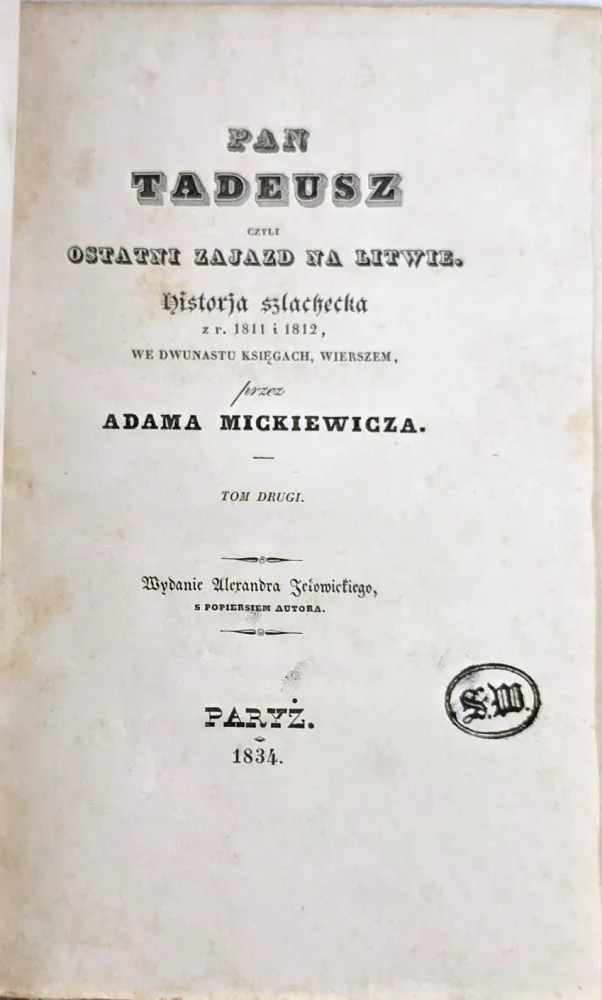
Adam Mickiewicz - Pan Tadeusz 1834. First print and first edition with the superexlibris "Jabłonka
Paris, 1834. The first edition of "Pan Tadeusz" by Adam Mickiewicz and the story of a copy whose old binding hides the superexlibris "JABŁONKA".
Adam Mickiewicz – Pan Tadeusz 1834. First print and first edition with the "Jabłonka" superexlibris
There are books that document history. There are also those that themselves have become part of it. The first edition of Adam Mickiewicz's "Pan Tadeusz," published in Paris in 1834, belongs to both of these categories. It is not only the first print of one of the most important works of Polish literature but also a testimony of the era in which Polish culture developed in exile, and the memory of the lost homeland gained special significance.
The described copy has yet another dimension: its own history, recorded in the old binding, signs of use, and the gilded superexlibris "JABŁONKA." Not all of its chapters can be reconstructed today. That is precisely why it is worth looking at this book not only as Mickiewicz's work but also as a collectible item that has survived almost two centuries.
Paris, 1834. A book published abroad
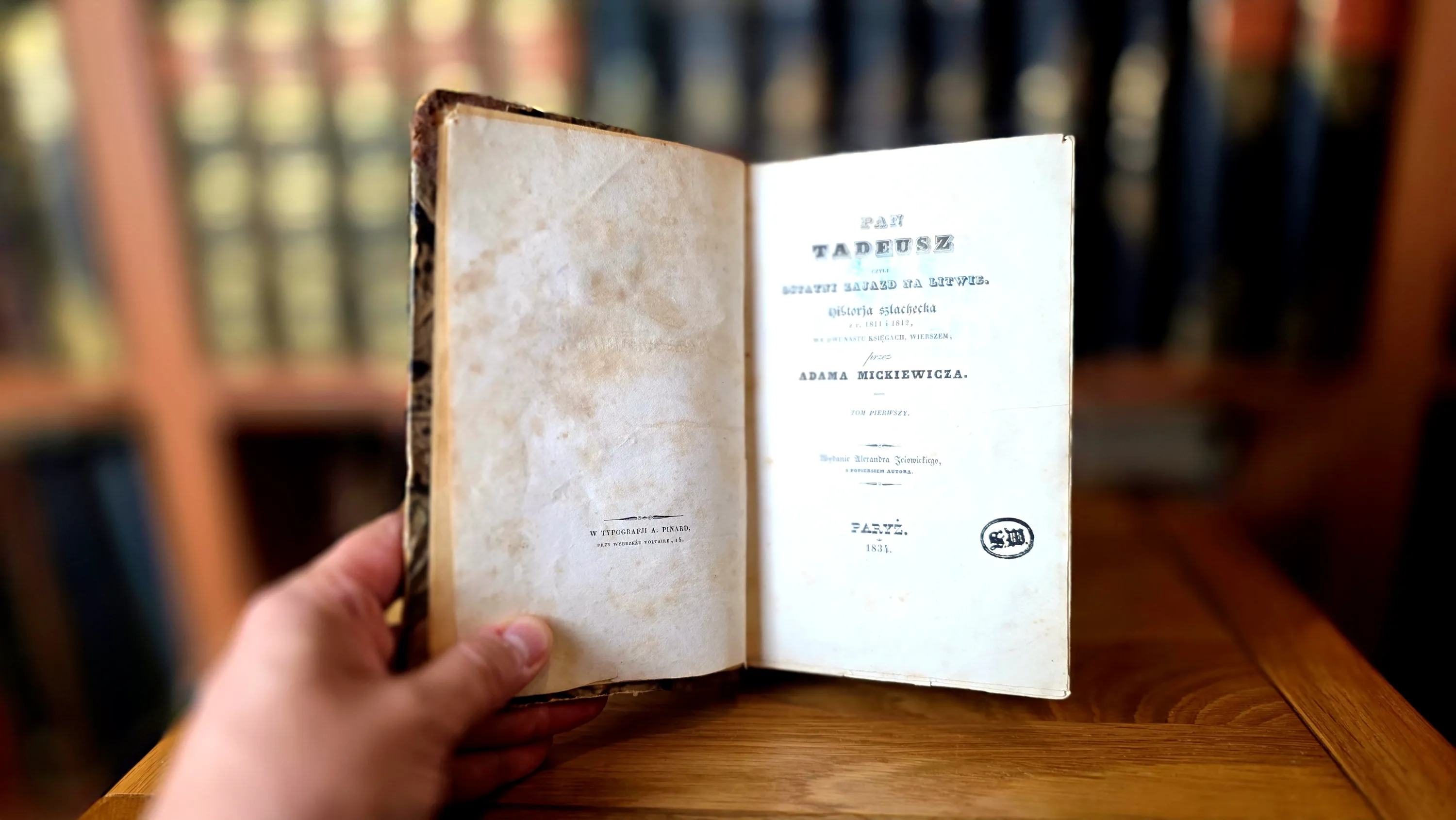
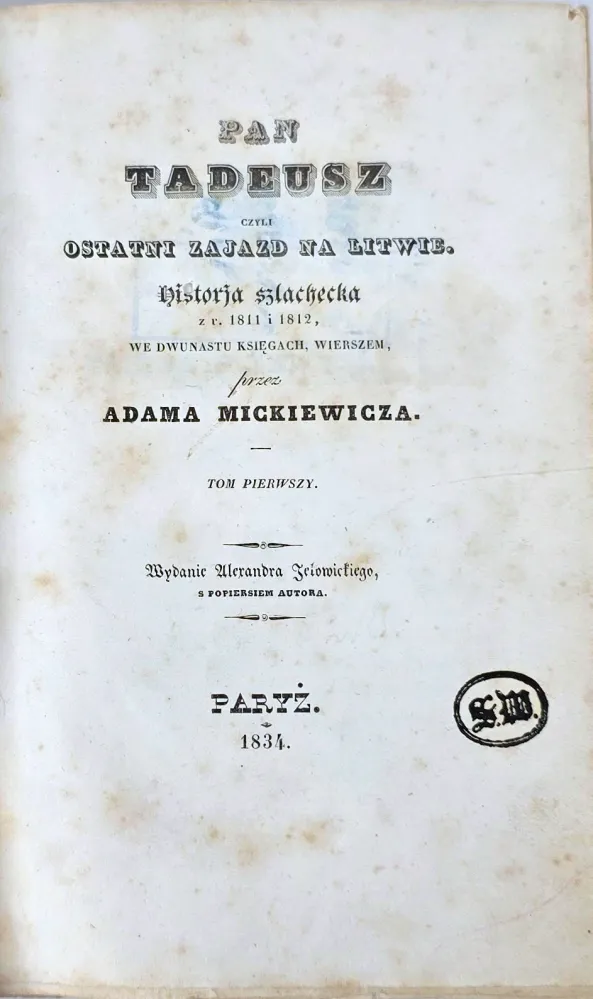
"Pan Tadeusz, or the Last Foray in Lithuania" was published in Paris in 1834 by Aleksander Jełowicki. Mickiewicz was then in exile. After the defeat of the November Uprising, Paris became one of the most important centers of Polish intellectual and political life.
Under these circumstances, a work was created that over time came to be seen as the Polish national epic. Mickiewicz described the world of noble customs, disputes, and rituals, setting the action in the years 1811–1812. He presented Lithuania as a space of memory, where landscape, language, cuisine, nature, and customs create an image of a lost world.
It is worth remembering that "Pan Tadeusz" is not only a story about the past. It is also a work written from the perspective of an emigrant, for whom the memory of his homeland gained special intensity. In this sense, the 1834 book is not only the beginning of the poem's publishing history but also a material testimony of Polish culture created beyond the country's borders.
The first edition has special significance for a collector: it allows one to encounter the work in its original book form, in the form in which it first reached readers. Later editions may be beautiful, carefully prepared, and richly illustrated, but they cannot replace this particular place in history.
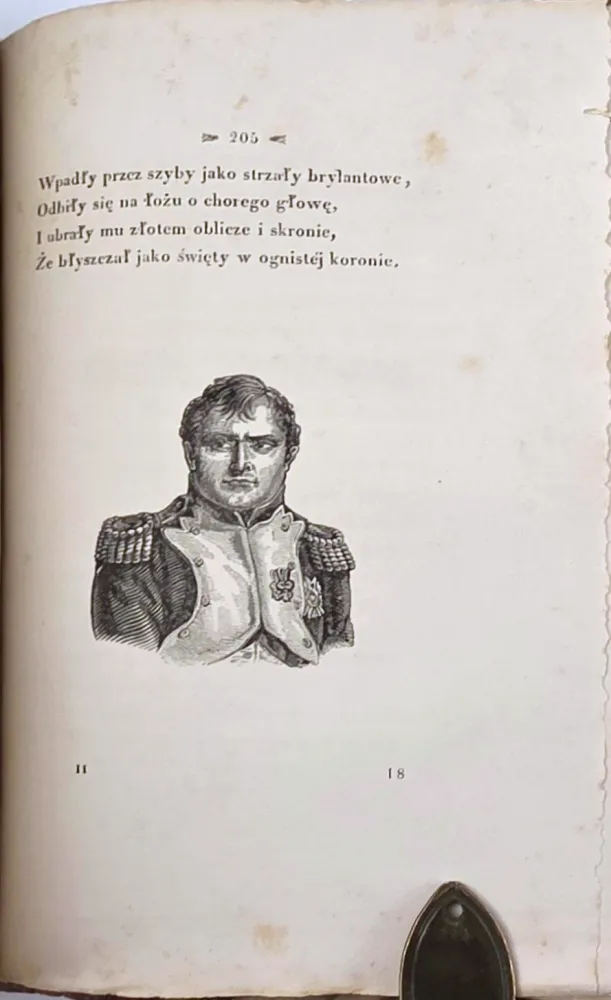
Napoleon on the pages of "Pan Tadeusz"
In the second volume of the described copy, on page 205, there is a small woodcut portrait of Napoleon Bonaparte. It is a small element that reminds us of the important historical background of the poem.
In Mickiewicz's world, Napoleon is associated with hopes for regaining independence. The events of 1811–1812, preparations for war with Russia, and the anticipation of political changes form an important context for the story. For the poem's characters, grand history — the history of states and armies — intertwines with local history: the life of the manor, neighborhood disputes, and daily rituals.
Thus, even a small illustration in the book can have greater significance than its size suggests. It is not merely a decoration of the page. It helps to interpret the publication in the context of the era, its hopes, and imaginations.
It is also worth paying attention to the completeness of specific copies. First editions may differ in condition, presence of plates and other elements, as well as later repairs or binding interventions. In the case of old books, the author's name and publication date alone are not enough — what counts is also what has actually been preserved in a given copy.
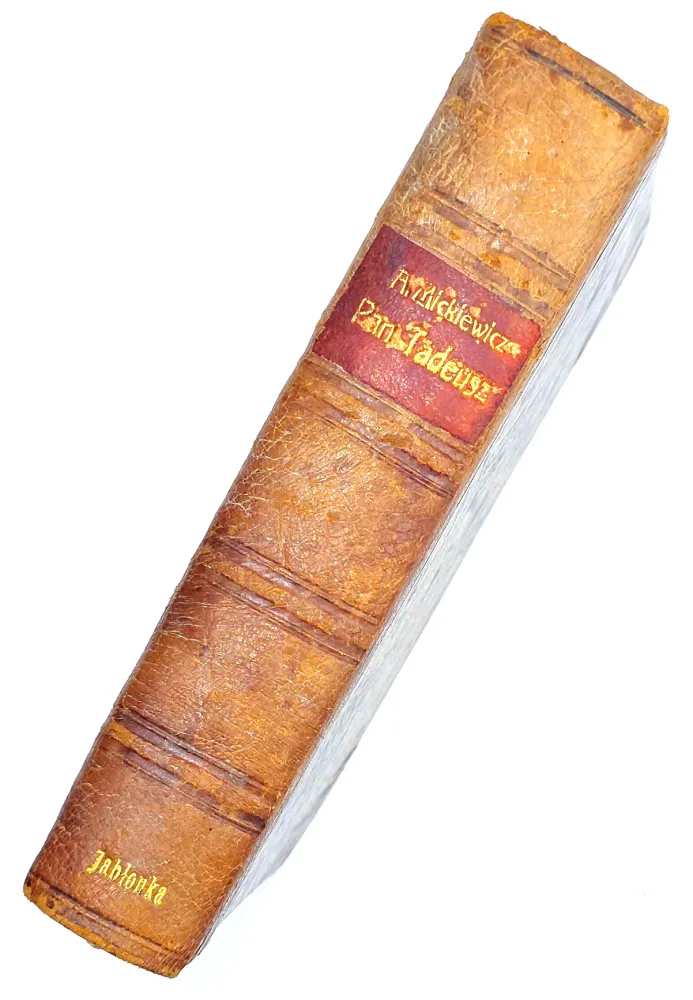
Old binding and wide margins
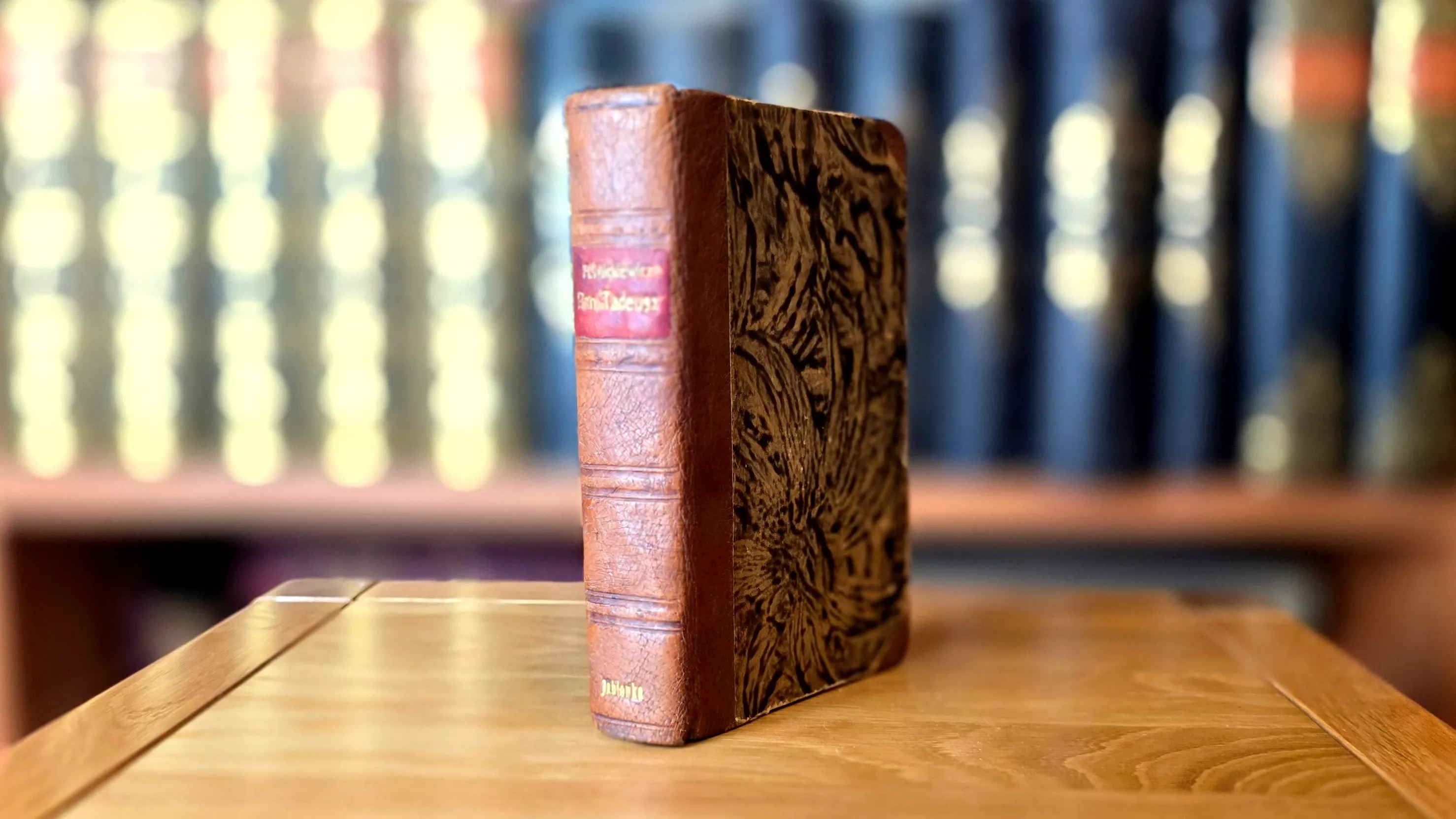
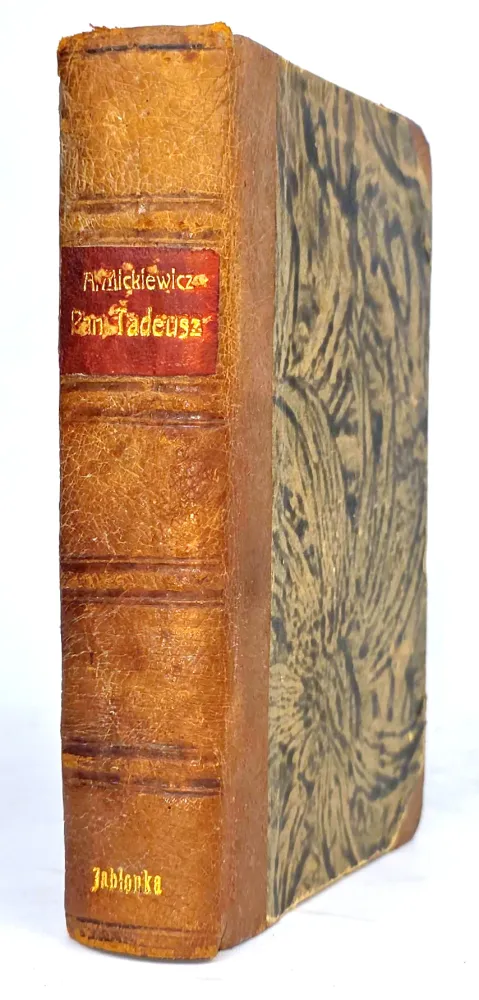
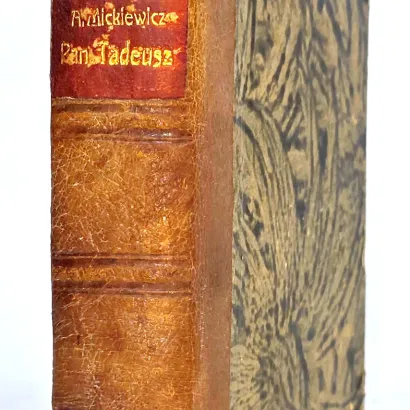
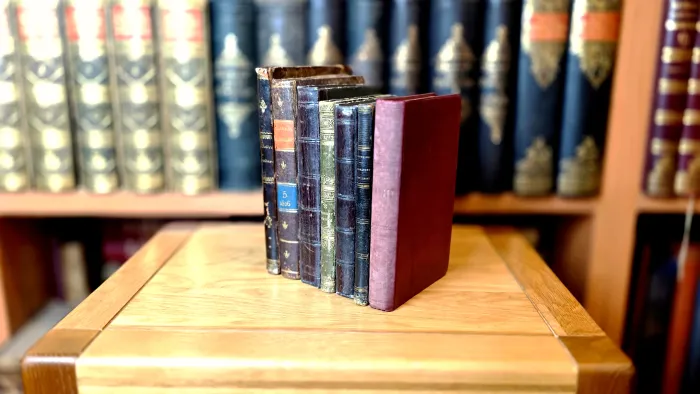
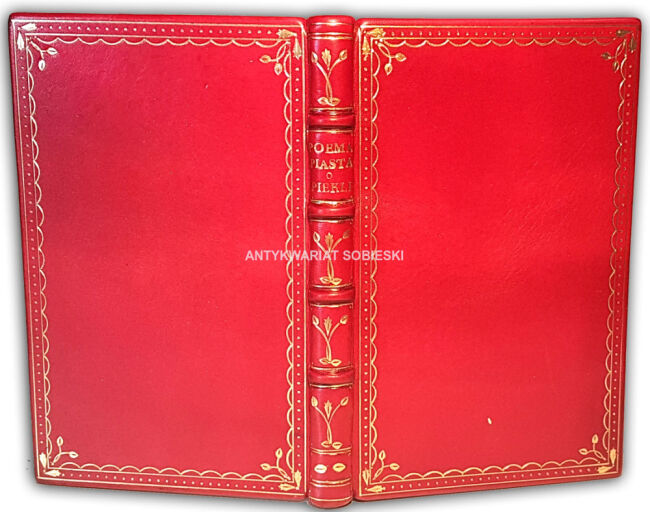
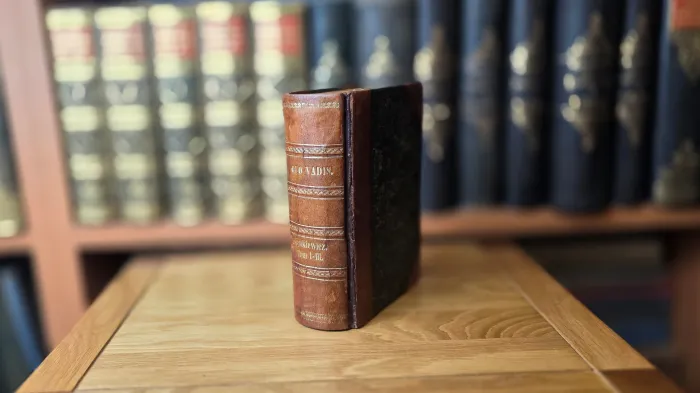
The described "Pan Tadeusz" has been preserved in a half-leather hardcover from the early 20th century. The spine is decorated with embossing and leather labels with gilded titles. In its lower part, there is a gilded superexlibris "JABŁONKA."
This is therefore not the binding from the time of the book's publication. It is separated from the first print by several decades, thus constituting a separate chapter in the history of the copy. This is an important distinction for a collector: an old binding may have its own aesthetic and historical value but should not be equated with the original publisher's binding or the binding from the era of the work's creation.
The book has very wide margins. In old prints and 19th-century books, margins can be an important element in assessing a copy. They may indicate that the pages were not excessively trimmed during later rebinding. This does not automatically mean that every copy with wide margins is more valuable than others, but it is a feature worth noting and evaluating in context.
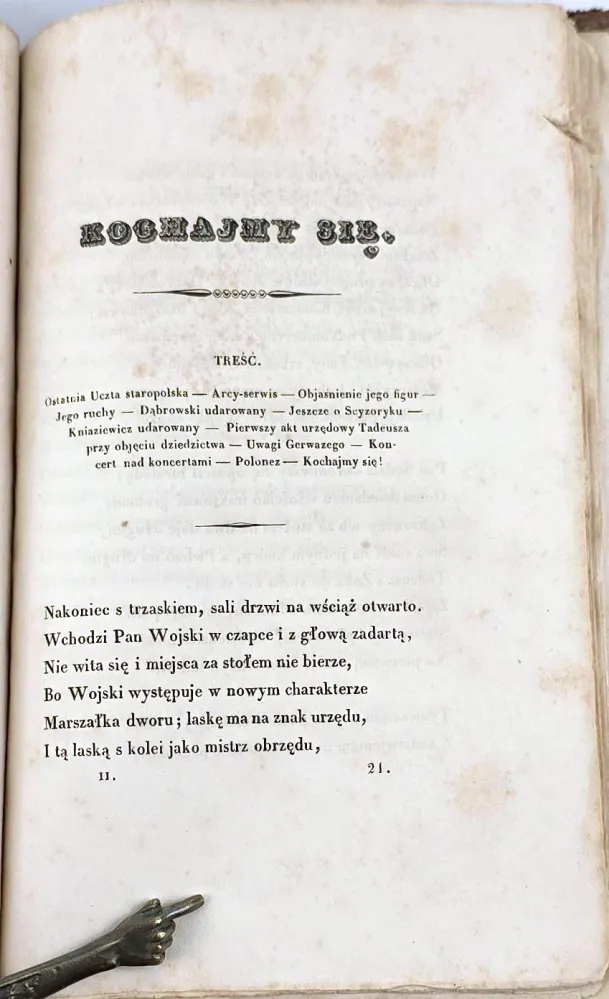
The condition of the described copy is assessed as good. There are visible edge abrasions on the binding, localized paper discolorations, an old ownership stamp with the initials "S.W.," and a trace of a removed ex-libris on the verso of the title page. There are also a few discolorations and minor defects on the final page margins. The copy is complete in terms of text; however, the portrait of Mickiewicz has not been preserved.
Such information does not automatically diminish the book's significance. On the contrary — it allows for an honest assessment without overlooking imperfections. In collecting, a reliable description is as important as the rarity of the object itself.
Superexlibris "JABŁONKA" — a trace of an old library
One of the most intriguing elements of the binding is the gilded superexlibris with the inscription "JABŁONKA." A superexlibris is a property mark placed directly on the book's binding. It can take the form of a coat of arms, initials, surname, or another mark related to the owner or their library.
In this case, the inscription may indicate a connection of the copy with an old library associated with Jabłonka near Dydnia, a historic estate in the Brzozów district. The history of this estate is linked to the Jaruntowski, Słonecki, and Kraiński families.
The manor in Jabłonka was built at the turn of the 18th and 19th centuries by Antoni Jaruntowski. In 1844, his daughter Marcelina, married to Zenon Słonecki, brought the estate into her husband's family. Around 1890, Jabłonka was acquired by Władysław Kraiński. His son, Antoni Maurycy Kraiński, was the last owner of the estate before its takeover during the post-war land reform.
This is an interesting lead, but caution is necessary: the inscription "JABŁONKA" alone does not prove that the book belonged to a specific owner or that it directly comes from the library of that manor. Additional sources would be needed to confirm such provenance — for example, a library catalog, estate documents, correspondence, an inventory of the library, or other ownership marks that can be linked to a particular person or place.
This is precisely the fascination of provenance research. One mark can open the way to further investigations, although it does not always allow for a definitive conclusion. Sometimes the history of a book can be reconstructed almost step by step. Other times it remains a collection of clues, each requiring separate verification.
Even incomplete knowledge about a former owner matters. It reminds us that the book did not exist in a vacuum: it was read, stored, bound, moved between places, and passed on to subsequent people. Today's copy is the result of all these events.
Why do we collect first editions?
First editions attract collectors for several reasons. The most important is simple: they are the first book witnesses of a work's presence in the reading circulation.
In the case of "Pan Tadeusz," we are talking about a publication from 1834 — a copy created at the same time the work first appeared in print as a book. Later editions may better meet contemporary readers' needs, contain commentary, footnotes, and illustrations, but they do not hold the same position in the history of the work's publication.
The first edition is not simply an older version of the book. It is a specific place in the history of literature, publishing, and readership. Its significance results from the combination of several elements: the author, the work, the date, the place of publication, the print run history, and the preserved copies.
It is also worth distinguishing the terms. First print means the first publication of a work, while first book edition refers to the first edition in the form of a separate book. In many cases, both terms refer to the same publication, but not always. A work might have appeared earlier in a magazine and only later been published as a book. Therefore, in bibliographic description, it is worth precisely determining what kind of priority we are dealing with.
First editions today can be difficult to obtain not only because of the original print run size but also due to the number of surviving copies, their condition, and market availability. The print run itself does not determine rarity: it also matters how many copies have survived and how often they appear for sale.
However, it should be remembered that age alone does not make a book rare, and rarity does not always mean a high price. Interest in a given author, the work's position in cultural history, condition, completeness, provenance, and current demand also matter. Collecting thus requires both passion and knowledge.
Will the value of first editions increase?
This question often arises, especially when collecting is combined with thinking about long-term capital investment.
In the case of important first editions, there are arguments supporting their lasting collector interest. The number of surviving copies of a specific historical edition is limited. It cannot be increased by reprinting, and subsequent generations of readers and collectors may continue to seek books related to the most important figures in literature.
The cultural value of such works does not depend solely on current trends. "Pan Tadeusz" remains one of the foundations of the Polish literary canon, and the first edition from 1834 has a clearly defined place in the history of the book. It is precisely the combination of the work's significance and the uniqueness of a particular edition that makes it interesting for bibliophiles.
However, this does not guarantee a price increase. The antiquarian book market, like other collector markets, is subject to changes. Prices depend on demand, market conditions, availability of copies, their condition, and quality of documentation. Interest in specific authors or types of publications rises at times and wanes at others.
It is therefore wiser to talk about the potential for maintaining interest and collector value rather than promising uninterrupted price growth. A well-chosen book can combine the pleasure of ownership, historical significance, and the possibility of resale in the future. However, not every book will bring profit, and the purchase should consider both knowledge about the item and one's financial capabilities.
The best starting point is choosing books that have significance regardless of temporary market conditions: important works, significant editions, publications with well-documented history, and copies whose condition and provenance can be reliably assessed.
A collection is more than just a set of expensive books
Collecting does not have to mean gathering the most expensive or most spectacular objects. A well-built library tells its own story. It can focus on one author, era, publisher, type of illustration, or a specific cultural phenomenon.
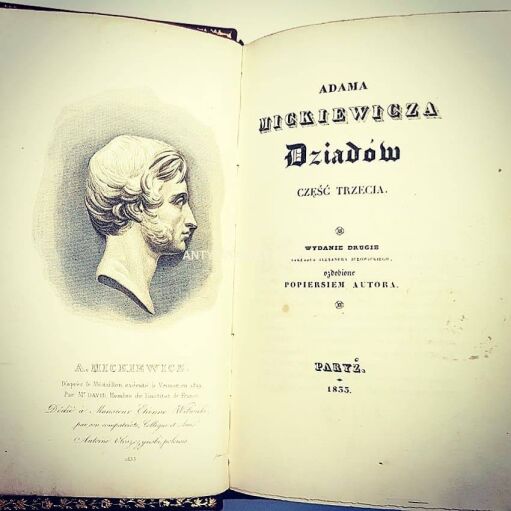
In this approach, the first edition of "Pan Tadeusz" can be the center of a Polish Romanticism collection. Alongside it may be first or early editions of "Dziady," works by Juliusz Słowacki, publications related to the Great Emigration, or books documenting the history of the Polish publishing movement. Each brings a different element, and together they allow one to see relationships between authors, eras, and successive stages of literary reception.
There is no need to limit oneself to the most famous names. Sometimes particularly interesting are books by less popular authors, publications with small print runs, regional editions, or copies connected with a specific library. The value of a collection may result not only from the price of a single volume but also from thoughtful selection and overall coherence.
Documentation is also important. It is worth keeping bibliographic descriptions, information about condition, previous owners, provenance marks, and purchase history. Photographs of bindings, title pages, ownership marks, and characteristic elements are also useful. Such documentation helps to better understand one's library, facilitates later research, and may be important when selling or transferring the collection.
A good collection is not created solely through purchases. It is also formed through reading, comparing editions, checking library catalogs, learning about printing history, and asking questions about each copy.
Mickiewicz, Słowacki, and other books that make literary history
"Pan Tadeusz" is a good starting point for a broader look at first editions of Polish literature. At Antykwariat Sobieski, we also examine other publications that show how complicated the history of the book can be.
In the article "Dziady" 1862. The first complete edition printed under the partitions, we describe another important edition related to Mickiewicz — a publication that allows looking at the history of his work from the perspective of the Polish publishing market under the partitions.
Meanwhile, the first edition of Juliusz Słowacki's "Beniowski" from 1841 reminds us that the history of Polish Romanticism is also the history of books published abroad, often under particular political and cultural circumstances.
It is also worth reading our text "Why it is worth buying first prints, first and early editions of literature". It offers a broader view of collectors' motivations, the importance of rarity, and factors influencing the value of old books.
Such examples show that collecting first editions does not have to be only about seeking individual costly volumes. It can become a way of learning literary history through its material testimonies.
Why is it worth preserving traces of a copy's history?
In the case of old books, it is easy to focus only on what is visible at first glance: the author's name, publication date, binding, or condition. Meanwhile, equally important can be less obvious traces — stamps, signatures, ex-libris, old repairs, notes, and library markings.
Not every such trace increases the book's value. Some entries may be unaesthetic, some stamps may obscure the text, and some interventions in the paper may reduce the condition. However, even these elements can have documentary significance. They show how the book was used and how its role changed over the decades.
It is worth distinguishing an interesting hypothesis from a confirmed fact. An ownership mark may suggest a connection with a specific person or place, but only additional sources allow such provenance to be considered documented. This caution distinguishes reliable provenance research from creating an attractive but unconfirmed story.
The history of a book is not always complete. Sometimes we do not know the name of the first owner, when the binding was changed, or how the copy reached the next library. Nevertheless, preserved traces allow asking questions and seeking answers. And the very awareness that the book had readers before us changes the way we look at it.
The book as a material witness of the past
The first edition of "Pan Tadeusz" from 1834 combines several dimensions. It is a testimony of Polish Romanticism and emigration, the first book form of one of the most important works of national literature, and at the same time a specific copy with its own history of binding and ownership marks.
It is not perfect. It shows signs of wear, discolorations, and losses within the margins of the final pages. The portrait of Mickiewicz has not been preserved. However, it has wide margins, an old half-leather binding, and the "JABŁONKA" superexlibris, which opens an interesting, though requiring further research, provenance thread.
For a collector, this is an important reminder: a book's value does not always boil down to perfect condition or the most decorative binding. Sometimes the greatest significance lies in its place in literary history, the rarity of a particular edition, and the possibility of reading the traces left by previous owners.
Collecting such books is therefore not only about gathering objects. It is also a form of care for the material testimonies of culture — for things that have survived changing borders, fashions, libraries, and generations of readers.
At Antykwariat Sobieski, we believe that a book with history deserves more than a brief catalog entry. It deserves a careful description, a reliable assessment, and an attempt to understand why this particular copy has survived to our times.
Author: Paweł Kołata, Antykwariat Sobieski
See the description of the first edition of "Pan Tadeusz" from 1834 in the offer of Antykwariat Sobieski:
Pan Tadeusz, vol. I–II, Paris 1834 — first edition
More books of special bibliographic and collector significance can be found in the section First book editions.
Antykwariat Sobieski - books with history.






 Polish