Leather Bookbinding from A to Z: Types of Leather, Bookbinding Techniques, and How to Choose a Lifetime Binding | Blog about Rare Books and Early Prints
How to choose a leather book binding? Discover the types of leather, binding styles, and bookbinding techniques that ensure durability for years.


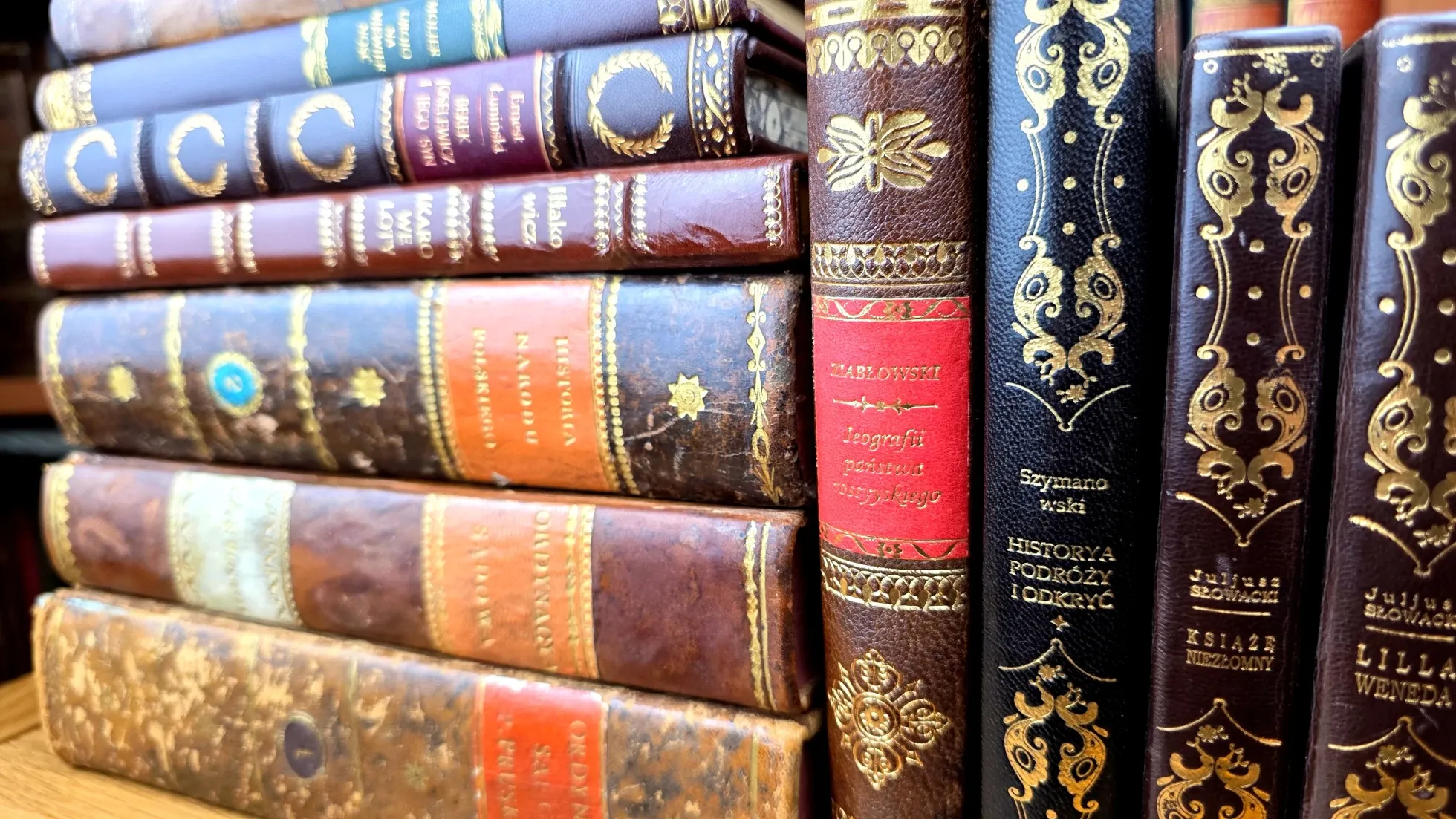
Leather Bookbinding from A to Z: Types of Leather, Bookbinding Techniques, and How to Choose a Lifetime Binding
Leather bookbinding is not just about aesthetics. A well-designed and properly executed genuine leather binding can extend the life of a volume by decades—or even centuries. For bibliophiles, collectors, or those seeking a truly exceptional gift, it is a “lifetime investment” in both protecting the content and creating a beautiful everyday object, as offered by Antykwariat Sobieski.
In this guide, you will walk step by step through the most important topics: the types of bookbinding leather, the differences between classic binding styles, what hand-bound leather bookbinding involves, how to choose a durable binding for years to come, and how to care for it. You will also see what the process of commissioning a binding looks like in a professional bindery—such as Antykwariat Sobieski, which specializes in leather bindings, artistic bindings, and presentation editions, as well as working with rare books for clients across Poland and internationally.
Leather Bookbinding – Who Is It For and When Is It Worth It?
Leather bookbinding is ideal wherever durability, prestige, and sentimental value matter most. It is a perfect solution for those who:
have a rare book, first edition, commemorative Bible, or prayer book that requires professional protection—such volumes can be found among first editions and rare books,
want to emphasize the importance of a collector’s edition or a classic literature series,
are looking for an elegant gift—for a wedding, anniversary, milestone, or business occasion, often in the form of a book for a bibliophile,
keep a family chronicle, guestbook, or commemorative album and want it to last for generations.
Unlike standard mass-produced glued bindings, hand-bound leather books are based on sewn text blocks and traditional bookbinding techniques. They also allow for extensive customization—choice of leather, color, decorations, lettering, and even custom heraldic or symbolic motifs. That is why we speak of a binding design rather than simply “replacing a cover.”
Antykwariat Sobieski combines two roles: an antiquarian bookstore offering rare and collectible editions, and a bindery workshop where genuine leather bindings, artistic bindings, and exclusive presentation bindings are created—for clients from Warsaw, Kraków, Wrocław, Poznań, Gdańsk, and beyond, including international customers.
Types of Bookbinding Leather – What to Choose?
Choosing the right material is the foundation of any durable binding. Below are the most important types of bookbinding leather.
Calfskin – the classic standard of elegance
Calfskin has long been considered one of the finest bookbinding materials:
it has a very smooth, fine-grained surface, giving it a refined appearance,
it is excellent for embossing and gilding, as well as decorative marbling,
it is flexible and relatively thin, making it ideal for precise work on spines and corners.
Today, high-quality calfskin (often vegetable-tanned and aniline-dyed) is used for:
full bindings of commemorative books, Bibles, and prayer books,
conservation bindings for rare books,
collector’s editions where understated elegance is key.
Goatskin – durability and character
Goatskin is considered one of the best materials for deluxe and conservation bindings:
it offers excellent resistance to wear and bending,
it is both thin and highly durable,
it features a characteristic “pebbled” grain,
it responds beautifully to gold tooling.
It is especially suitable for:
books used frequently,
collector’s editions,
artistic bindings.
Pigskin – practical durability
Pigskin:
is naturally thick and very durable,
features visible pore patterns,
withstands heavy use well.
It is commonly used for functional bindings such as registers, archival books, and records.
Lambskin / Sheepskin – softness and delicacy
Lamb or sheepskin:
is very soft and pleasant to the touch,
but less resistant to wear and stretching.
It is best suited for smaller formats and presentation bindings rather than heavy daily use.
Cowhide – strength and solidity
Cowhide:
is used especially for larger formats (albums, guestbooks),
provides excellent durability,
offers a more robust, less delicate appearance.
Parchment – a special material
Parchment:
is not tanned but stretched and dried,
is extremely strong but sensitive to humidity,
has a smooth, slightly translucent surface.
It is mainly used in historical and conservation bindings.
Leather Finishes
The type of finish greatly influences the final look.
Full-grain leather
- the most natural and durable,
- ages beautifully,
- ideal for gilding.
Suede and nubuck
- soft and visually interesting,
- more prone to staining.
Embossed leather
- decorative textures and patterns.
Marbled and patinated leather
- antique-style appearance,
- ideal for historical bindings.
Types of Leather Bindings
Full leather binding
- entire cover in leather,
- most prestigious option.
Half leather binding
- leather spine and corners,
- balance of cost and durability.
Quarter leather binding
- leather only on the spine,
- more economical solution.
Sewn vs. Glued Bindings
Sewn text block
- highly durable,
- opens flat,
- ideal for long-term use.
Glued binding
- cheaper,
- less durable.
Decorative Techniques
Gilding
- gold foil decoration,
- titles, ornaments, crests.
Blind embossing
- subtle, elegant effect.
Raised bands
- classic spine structure.
How to Choose a Lifetime Binding?
- Usage
- frequent → goatskin + sewn binding
- occasional → more decorative options
- rare books → conservation approach
- Material
- durability → goatskin
- elegance → calfskin
- Style
- classic, minimalist, artistic, historical
- Budget
- simple bindings: from a few hundred PLN
- artistic bindings: several thousand PLN
Leather Binding as a Gift
Perfect for:
- weddings,
- anniversaries,
- business gifts.
Consider:
- personalization (initials, dates),
- presentation box,
- proper book selection.
Care for Leather Bindings
Avoid:
- sunlight,
- humidity extremes,
- chemicals.
Clean:
- with a soft cloth,
- without detergents.
Store:
- upright,
- in stable conditions.
Ordering Process
- Book assessment
- Material and design selection
- Pricing
- Execution and delivery
FAQ
Can an old binding be repaired?
Yes, depending on its condition.
Is leather binding always expensive?
No—cost depends on materials and complexity.
Can I order remotely?
Yes, many projects are handled remotely.
Summary
Leather bookbinding is an investment in durability, beauty, and individuality. To choose a lifetime binding:
- select high-quality leather,
- choose a sewn structure,
- match style to purpose,
- ensure proper care.
A well-crafted binding not only protects the book but becomes part of its identity—often lasting for generations.
Sources
[1] Leather for bookbinding – an overview, Schmedt: https://www.schmedt.com/infos/magazine-news/leather-for-bookbinding-an-overview/
[2] Genuine Calfskin Bookbinding Leather – Talas: https://www.talasonline.com/fabrics-and-leather/leather/calfskin
[3] A Primer on Bookbinding Leather – r/bookbinding: https://www.reddit.com/r/bookbinding/comments/4kvbtq/a_primer_on_bookbinding_leather/
[4] Materiały obleczeniowe opraw – Leksykon oprawoznawczy: http://leksykon.oprawoznawczy.ukw.edu.pl/index.php?title=Materia%C5%82y_obleczeniowe_opraw
[5] Skóra – kaletnik.info: https://kaletnik.info/skora-z-czego-sie-sklada-jakie-typy-skor-wyrozniamy/
[6] Oprawa książek – Ossolineum: https://dbc.wroc.pl/Content/126334/Oss-B-170464-X-57a.pdf
[7] Tusting & Burnett: https://www.tustingandburnettshop.com/products/natural-veg-tanned-bookbinding-goats
[8] Royal Society of Chemistry: https://books.rsc.org/books/edited-volume/1748/chapter/2318447/Leather-and-Parchment
[9] Conservation Wiki: https://www.conservation-wiki.com/wiki/BPG_Parchment_Bookbinding
[10] Pimlico Bookbinding: https://pimlico-bookbinding.co.uk/library/what-materials-are-used-for-bookbinding/
[11] Biblio: https://www.biblio.com/book-collecting/care-preservation/leather-binding-terminology-and-techniques/
[12] Siegel Leather: https://siegelleather.com/reference/




![KRASZEWSKI- POLSKA W CZASIE TRZECH ROZBIORÓW t. I-III [KOMPLET] wyd. 1885r. OPRAWA ilustracje](/media/products/a63ad9224e879281828b1d415af956c3/images/thumbnail/small_DSC07771.JPG?lm=1765538494)



![FALKOWSKI - OBRAZY Z ŻYCIA KILKU OSTATNICH POKOLEŃ W POLSCE. t.1-5 [komplet w 5 wol.] skóra Napoleon](/media/products/03d51e5bc66da2a3563a47e6c4868c4a/images/thumbnail/small_20200319-115900.jpg?lm=1765538220)




 Polish