"Polska. Jej dzieje i kultura" (1927–1928) - when a popular edition becomes a collectors item
"Polska. Jej dzieje i kultura" (1927–1928) — complete set in a rare binding and signed dust jackets by Tadeusz Gronowski;
a monumental interwar edition of the Second Polish Republic in navy cloth binding, with a rare publisher’s variant and provenance inscription "Warzecki"
"Polska. Jej dzieje i kultura" (1927–1928) — complete set in a rare variant of artistic binding
The three-volume work "Polska. Jej dzieje i kultura", published in 1927–1928 in Warsaw by Trzaska, Evert and Michalski, is one of the most important synthetic studies of Polish history from the interwar period. The publication had a monumental character — both in terms of content and editorial design — and was conceived as a representative compendium of the history of the Polish state and culture.
The set includes:
T. I: from prehistory to 1572
T. II: 1572–1795
T. III: 1796–1930
Each volume contains rich illustrative material: maps, plates (including color ones), charts, and numerous iconographic studies, emphasizing the encyclopedic and representative character of the edition.
Authors — the elite of Polish humanities and scholarship
The work was created with the participation of leading representatives of Polish historiography and related disciplines, including:
Bronislaw Gembarzewski — military historian, director of the Polish Army Museum, researcher of Polish arms
Oskar Halecki — outstanding historian of East-Central Europe, later professor in the USA
Aleksander Bruckner — one of the most prominent Slavic scholars and researchers of Old Polish culture
Waclaw Tokarz — historian of national uprisings and military affairs
Marian Kukiel — historian and Polish Army general, later minister in the government-in-exile
Wladyslaw Sobieski, Stanislaw Arnold, Jan Stanislaw Bystron and other leading scholars of the period
The group of authors represents the highest level of Polish humanities in the Second Polish Republic.
Binding — rare edition variant
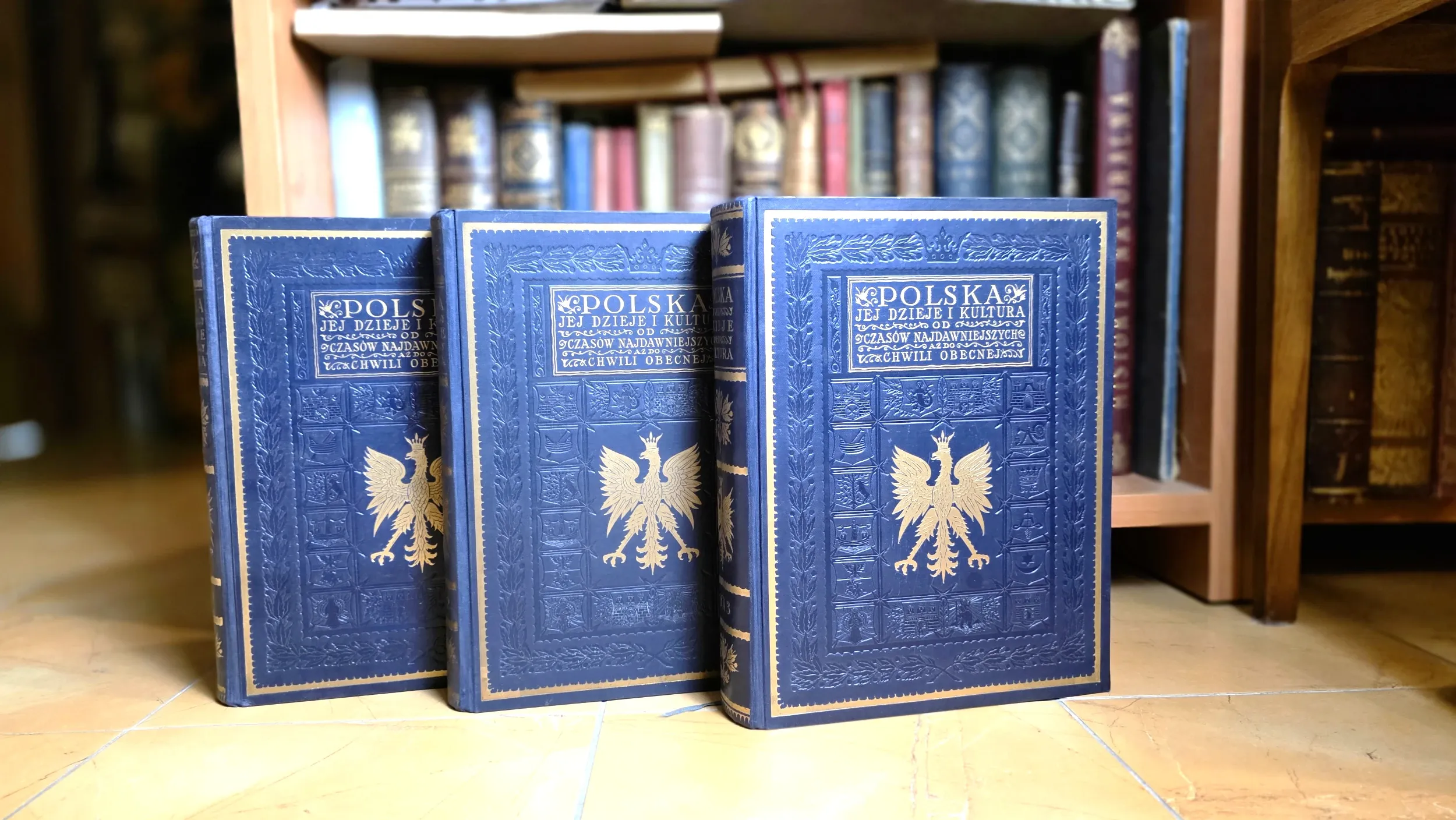
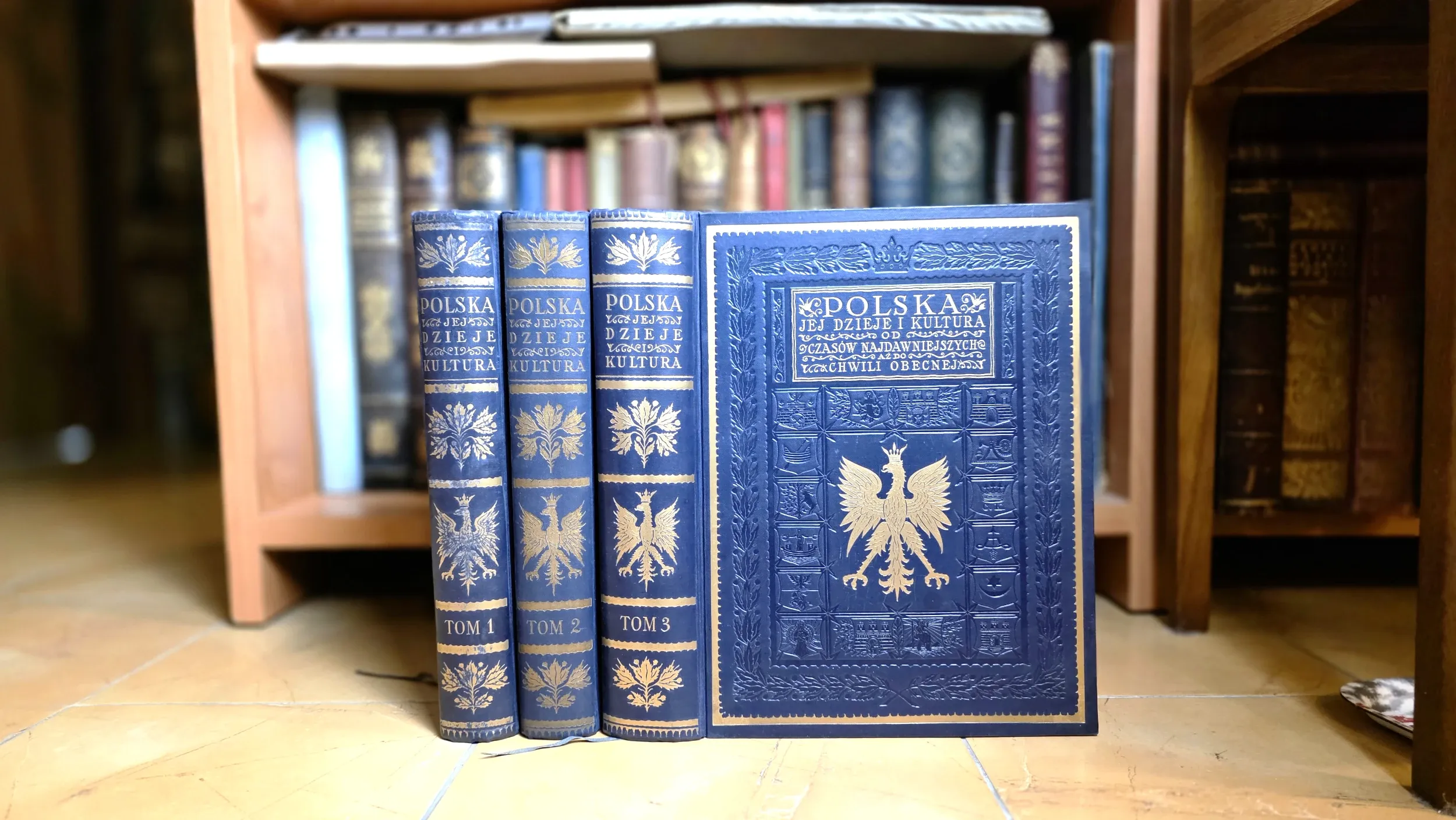
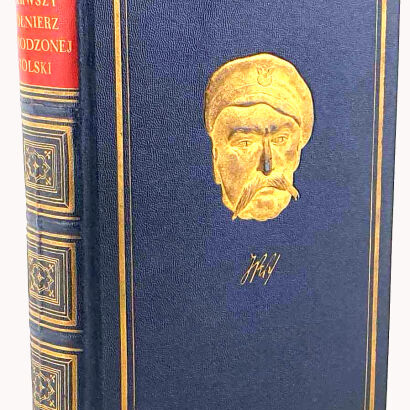
The copy features its original cloth binding in a rare color variant (navy blue). The binding has a representative and decorative character.
Features:
hard cloth binding
embossed design with an eagle and 16 coats of arms of voivodeship cities
decorative spines repeating the eagle motif
binder’s mark: monogram FJR
The binding was designed by Franciszek Jerzy Radziszewski and executed by a Warsaw artistic bookbinding workshop, placing it within the highest level of Polish interwar bookbinding craft.
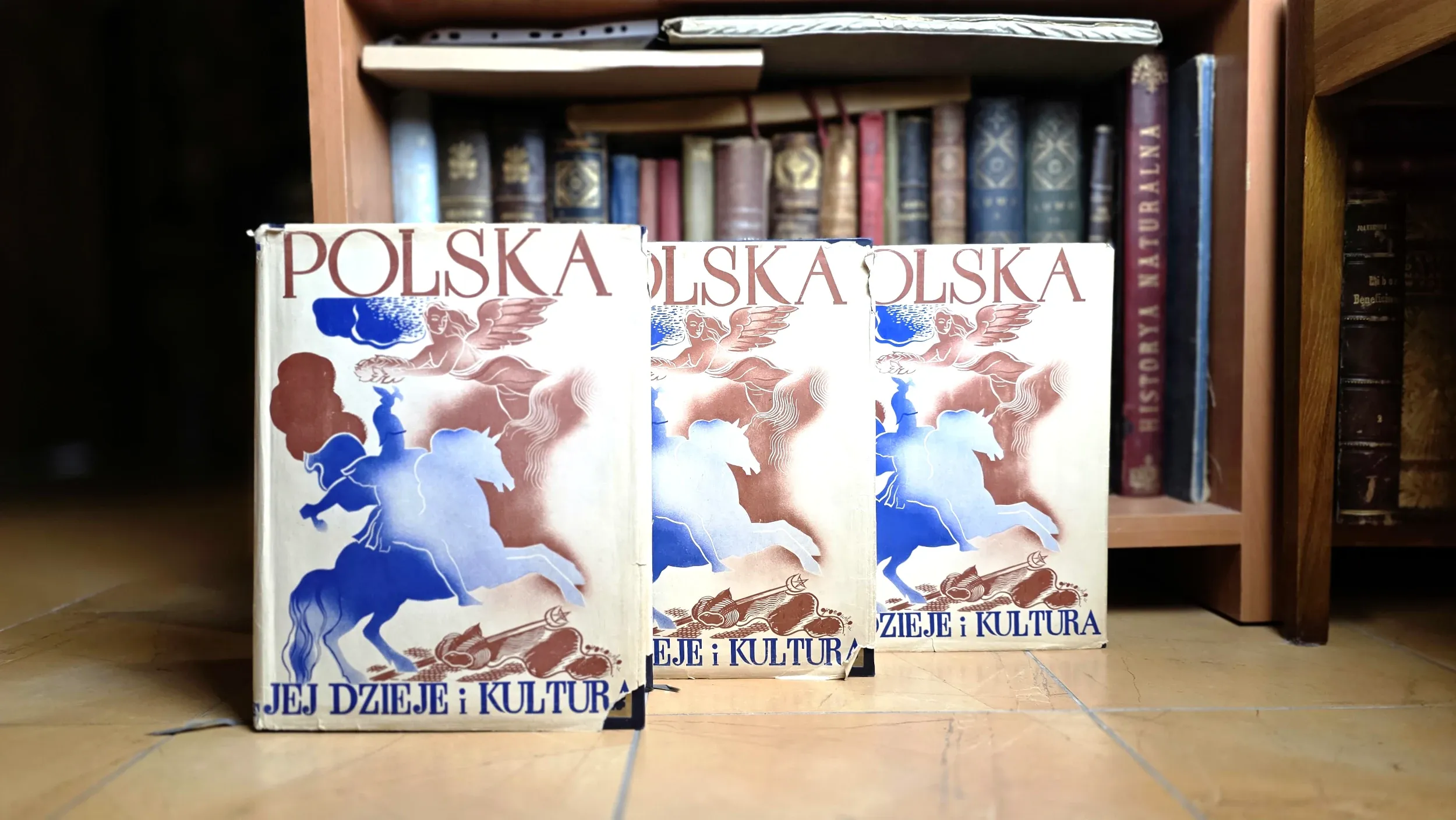
Dust jackets — design by Tadeusz Gronowski
The set includes original publisher’s dust jackets in Art Deco style, preserved in a rare complete set.
The dust jackets are signed by Tadeusz Gronowski, which provides a clear attribution of the graphic design.
Tadeusz Gronowski (1894–1990) was one of the most important Polish graphic designers, illustrators, and visual artists of the interwar period. He created posters, visual identities, book illustrations, and publishing designs, helping to shape modern Polish graphic design. He is considered a pioneer of the Polish artistic poster and a key figure of Polish Art Deco.
His work is characterized by:
geometrization of forms
synthetic, simplified composition
distinct typographic rhythm
elegance and decorative qualities typical of Art Deco
The dust jackets in this copy represent a conscious design of the book as a coherent graphic object of high artistic value.
Condition and provenance
The set is preserved in very good / near mint condition, with minor signs of use (including slight rubbing on the spines and minor defects in the dust jackets).
Distinguishing features:
complete three-volume set
original dust jackets preserved (rare on the market)
rare navy blue cloth binding variant
very good condition of the book blocks
ownership inscription "Warzecki" on the endpaper
Collectible character
Although the work itself is relatively well-known and present on the antiquarian market, copies in such condition are rare.
The value of this set is determined primarily by:
completeness and preservation state
presence of original dust jackets
signed graphic design by Tadeusz Gronowski
decorative and rarely encountered publisher’s binding
As a result, this is not only a historical publication, but also a collectible object of clear artistic and bibliophilic character, representing a high level of Polish interwar book culture.
![POLSKA JEJ DZIEJE I KULTURA t. I-III [komplet] oryginał, rzadki wariant oprawy, obwoluty](/media/products/9f01a8b0345570f3b1a07f1d8125b98f/images/thumbnail/small_wenet20260421-145219.jpg?lm=1776851158)
![POLSKA JEJ DZIEJE I KULTURA t. I-III [komplet] oryginał](/media/products/f10c67567c8d740c82812926e18089f7/images/thumbnail/small_batch-20240704-120456.jpg?lm=1765540564)
![POLSKA JEJ DZIEJE I KULTURA t. I-III [komplet] oryginał, rzadki wariant oprawy](/media/products/e60672e32dbb787da3cce569dcc52758/images/thumbnail/small_20201113-093239.jpg?lm=1765540003)
![POLSKA JEJ DZIEJE I KULTURA t. I-III [komplet] oryginał](/media/products/b686c868b7c5c6147b729122479971a0/images/thumbnail/small_batch-20230719-121907.jpg?lm=1765540539)
![POLSKA JEJ DZIEJE I KULTURA t. I-III [komplet] oryginał nieobcięty!](/media/products/2c5d7859af97f79ea852b2f951030962/images/thumbnail/small_20200427-131653.jpg?lm=1765540009)

![POLSKA JEJ DZIEJE I KULTURA t. I-III [komplet] oryginał](/media/products/8a664362bd704bd6cd61991810b6a6c6/images/thumbnail/small_batch-20240604-124019.jpg?lm=1765540591)






 Polish