Leon Sapieha. Africa, great hunts and the story of an extraordinary expedition.
Elephants, gorillas, the Ituri forests, the Kivu volcanoes, and trophies from expeditions nearly a hundred years ago. Discover the story of Prince Leon Sapieha – traveler, hunter, and author of extraordinary accounts from Africa.

Leon Sapieha. Africa, great hunts and the story of an extraordinary expedition.
When we open “The Ituri Forests” by Leon Sapieha, it is hard not to notice more than just the story of the hunt itself. There are maps, hundreds of photographs, descriptions of people and places, details about the organization of the expedition, tracking animals, crossings, and camping. It is clear that the author did not just want to tell what he hunted.
He wanted to preserve the entire expedition.
And perhaps that is why Sapieha’s books are today more interesting than ordinary safari memoirs.
Who was Leon Sapieha?
Leon Aleksander Adam Prince Sapieha (1883–1944) belonged to one of the most famous Polish aristocratic families. He was the owner of vast estates, a man connected with the landed gentry tradition, but also a soldier, traveler, and hunter.
During World War I, he served in the Austro-Hungarian army – first as a cavalryman, later as a pilot. After Poland regained independence, he returned to managing his estate and public activities.

Photo: Leon Sapieha – prince. Posed photograph, black and white photo, dated between 1920–1934. The photo was published in the weekly “Światowid”, no. 501/12 from March 17, 1934. The photographer is unknown; the material was documented by Tadeusz Łuniewski. The photograph is in the collections of the National Digital Archives, ref. 3/1/0/6/2180.
Africa appeared in his life in a way characteristic of the era. Not as an organized trip, but as an undertaking requiring preparation, money, permits, equipment, guides, and people capable of moving in terrain that a European traveler often simply did not know.
Sapieha went there as a man from a certain world – a landowner, hunter, and collector. But he also returned as a documentarian.
The first expedition
In 1926, Sapieha set off to Africa with his wife Katarzyna née Potocka. Through Congo, he reached Stanleyville, and from there the expedition towards the Ituri forests began.
This is the stage described in “The Ituri Forests. Travel Memories”, published in Krakow in 1928.
Sapieha received permission to shoot eight elephants and one okapi. Ultimately, he obtained eight elephants. One of them was distinguished by tusks weighing almost 80 kilograms. However, it was not only about the number of trophies obtained.
During the expedition, Sapieha photographed and filmed. In one of the accounts, he even mentions boys carrying the necessary cinematographic equipment. So the expedition had its own visual documentation even before the book was created.
This is important because thanks to this “The Ituri Forests” are more than just a hunter’s diary. It is a record of the expedition.


The hunter who observed
The way Sapieha describes the hunt says a lot about the hunting culture of that time.
His accounts include tracking, assessing the animal, choosing the right specimen, waiting for the right moment, and – very often – a detailed description of what happened afterward.
Sapieha paid attention to the trophy. He described the size of horns, tusks, or skin. But at the same time, he was interested in the animal itself.
In one account, he recalls a situation where the observed animal did not represent appropriate value for him as a trophy. Instead of shooting, he photographed it.
This is an interesting detail because it shows that the camera was as important a tool for him on the expedition as his weapon.
During a buffalo hunt, he even describes the approach to the herd, successive shots, and tracking the wounded animal. Ultimately, he obtained a specimen whose horns had a span of 111 cm. Some of the buffaloes he obtained were donated to the university museum in Warsaw.
Today, of course, we read such accounts differently than readers did in the 1920s and 1930s. However, the history of hunting is also the history of its era. Sapieha’s books allow us to see what a great hunting expedition in Africa looked like almost a hundred years ago – before laws, borders, travel methods, and the very approach to wildlife conservation changed.

Elephant, buffalo, gorilla
In “The Ituri Forests”, the main roles are played by the equatorial forest and elephants.
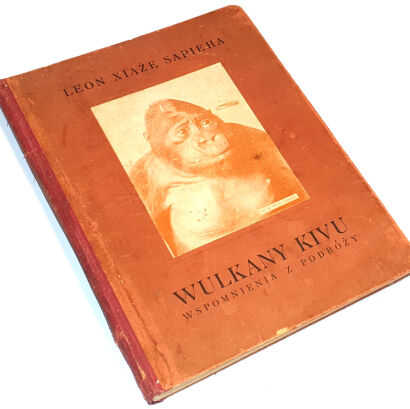
In “The Kivu Volcanoes”, published in 1934, the scenery changes completely. High mountains, volcanoes, lakes, and forests covering the slopes of Virunga appear.
Sapieha describes, among other things, a camp at an altitude of about 3200 meters. At night, the temperature dropped to zero. Beyond were volcanoes, clouds, steam, solfataric fields, and difficult ascents.
And then gorillas.
The expedition in search of them lasted two days. Sapieha, together with his wife and local guides, pushed through the forest. Eventually, they found a herd of eleven individuals.
Reading this passage today, it is worth paying attention to something else: Sapieha devotes a lot of space to the very approach to the animals. He describes the terrain, altitude, weather, vegetation, and the behavior of the guides.
Thanks to this, we have not only the story of the hunt but practically a diary of the expedition.

Africa did not end with safari
Also interesting is Sapieha’s later connection with Kivu.
In 1930, he obtained permission to establish a plantation. In Negesho by Lake Mokoto, he purchased 500 hectares of land and began trials of coffee and tea cultivation. He also planned to build a house and tried to grow European vegetables.
This shows that his interest in Africa was not limited to one hunting expedition.
It was an attempt to enter the life of this continent in a completely different way – as a traveler, landowner, and investor.
In the following years, the Sapiehas also traveled to other parts of Africa as well as Turkey and North Africa.


Trophies that survived the expedition
In Sapieha’s case, we have a rare situation where books can be connected with preserved material traces of his expeditions.
One of them was a leopard skin from the hunting expedition to Africa in 1927. This item has been preserved and later appeared on the auction market as a trophy attributed to Sapieha. The auction catalog also noted its earlier stay in a museum deposit.
This is a very interesting context for “The Ituri Forests.”
We have three different kinds of souvenirs from the same expedition culture:
the book – photographs – trophy.
Each of them tells this story a little differently.
The book tells where Sapieha was and what he saw. The photographs show people, animals, and landscape. The trophy is
 the physical trace of a specific hunt.
What exactly are we collecting?
And here begins the more interesting part for the collector.
Sapieha’s books may interest several different groups.
For the collector of travel literature, they are an account of an expedition to East and Equatorial Africa.
For the lover of African history, they are a document of a specific colonial period and the way a European traveler described the regions visited.
For the collector of hunting literature, they are a testimony of pre-war culture of great hunts, with descriptions of tracking elephants, buffaloes, and gorillas.
For the naturalist and collector of books about fauna, the observations of animals themselves, photographs, and descriptions of their environment are important.
And finally, there is also the collector of the history of great expeditions – for whom maps, expedition routes, equipment, organization, local guides, and photographic documentation are as important as the hunt itself.
That is why Sapieha is interesting.
You do not have to be exclusively a hunting enthusiast to be interested in his books. Nor do you have to collect travel literature. These two volumes intersect in several collecting areas at once.

Two books and a trace of one era
“The Ituri Forests” and “The Kivu Volcanoes” were published separately – the first volume in 1928, the second in 1934. On the auction market, both titles also appear separately; they have been listed, among others, by Rara Avis.
This makes the set of both volumes even more interesting.
Not because they are simply “old” or “rare,” but because together they allow one to go through the two most important stages of Sapieha’s African experiences: Ituri and Kivu, elephants and gorillas, equatorial forest and volcanic mountains.
And above all, they show the way of thinking of a man of his era.
Sapieha set out with a weapon but also took a camera. He returned with trophies but also with material for a book. He described the hunt but at the same time documented the landscape, people, animals, and the course of the entire expedition.
And perhaps that is why, after almost a hundred years, it is still worth opening these books.
Author: Paweł Kołata
Antykwariat Sobieski




![BIBLIOTEKA PODRÓŻNICZA t.1-20 [komplet] mapy, ilustracje](/media/products/767e39e6e1f591b021d03d49dbf5825e/images/thumbnail/small_20190523-093856.jpg?lm=1765539355)




 Polish