Henryk Sienkiewicz – "Quo vadis?" The first book edition and literary prelude
Two years before the first book edition of "Quo vadis?" Sienkiewicz published the novella "Let Us Follow Him!" in volume XX of his "Writings". Both works are connected by the ancient world, the beginnings of Christianity, and the theme of spiritual transformation. We look at the first editions of both texts and examine why "Let Us Follow Him!" can be considered a literary prelude to "Quo vadis?".
The First Book Edition of "Quo vadis?" and Its Literary Prelude
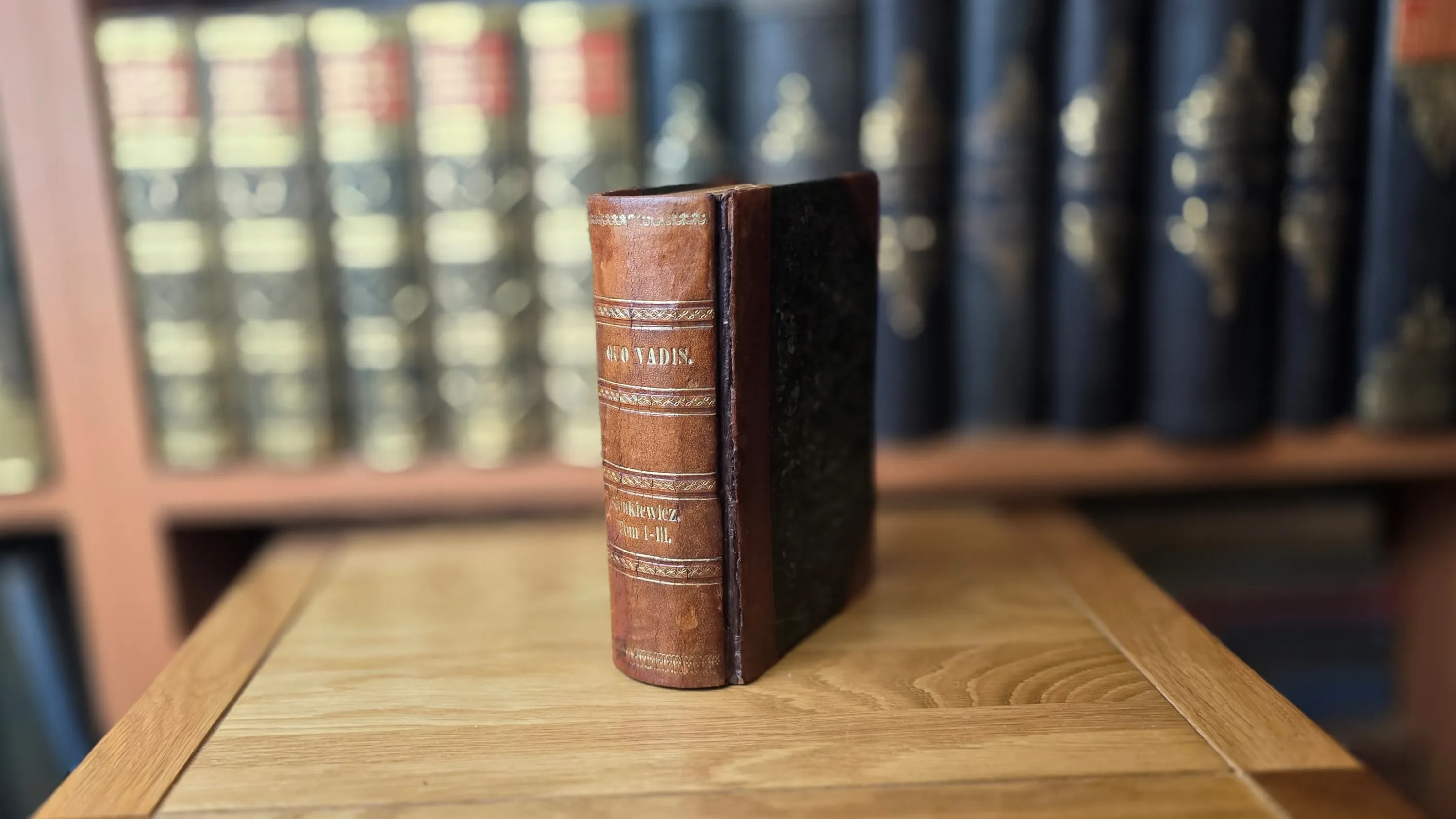
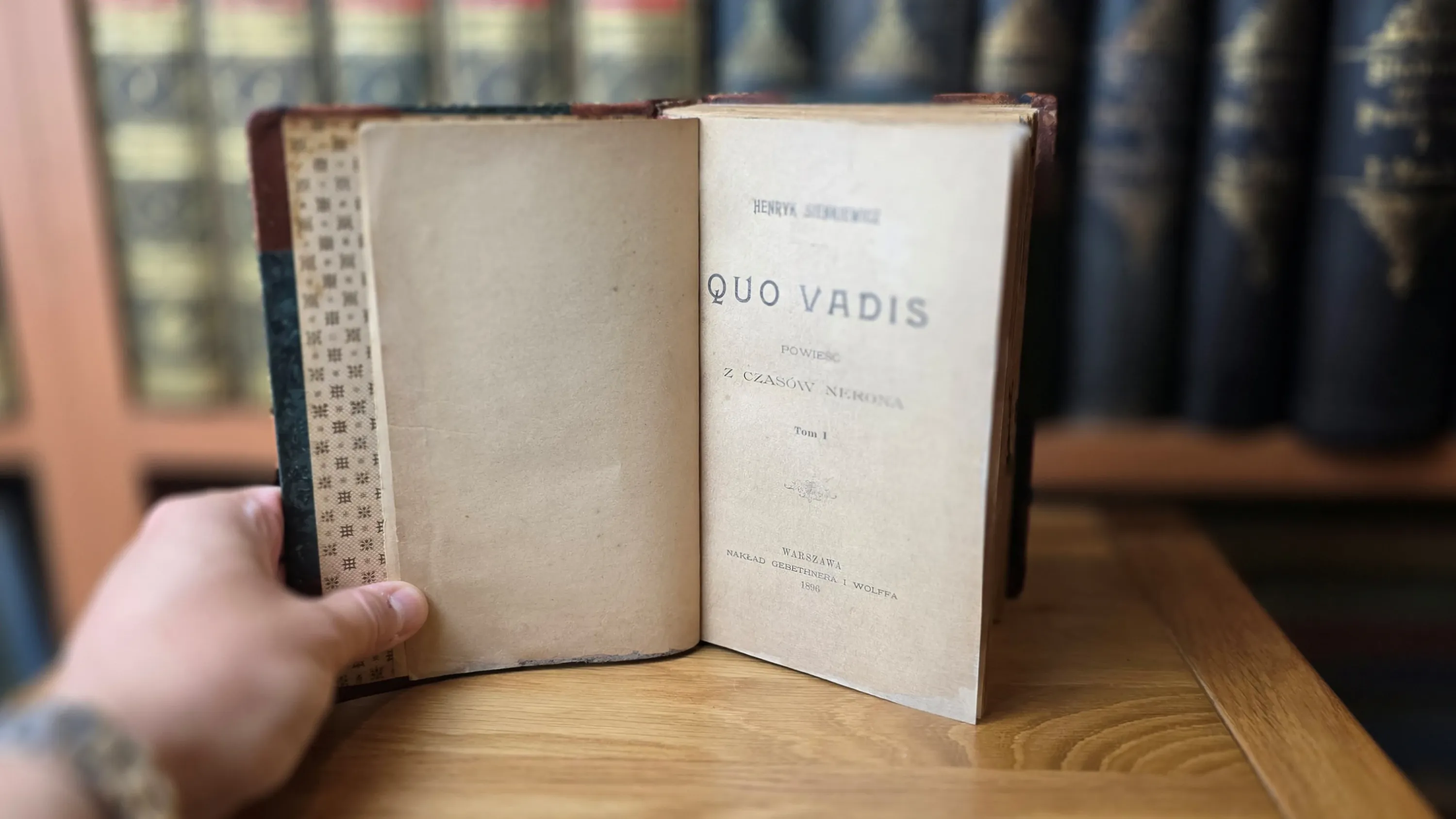
Henryk Sienkiewicz – "Quo vadis. A Novel from the Times of Nero". Warsaw, Gebethner and Wolff, 1896.
The first independent book edition of one of the most famous Polish novels. Published in three volumes, "Quo vadis?" was released by Gebethner and Wolff in 1896, after the novel had previously been printed in installments. The National Library identifies 1896 as the year of the first printed publication of "Quo vadis?" by Gebethner and Wolff.
The novel was written between 1894 and 1896. Its press publication began in 1895, and a year later the entire work appeared for the first time as an independent book publication. The first edition includes three volumes: 309, 253, and 345 pages.
For collectors, however, a particularly interesting fact is that a few years earlier Sienkiewicz had already addressed themes that would be developed on a much larger scale in "Quo vadis?".
"Let Us Follow Him!" – a Literary Prelude
In 1894, Gebethner and Wolff published volume XX of "The Writings of Henryk Sienkiewicz". It contained eight works, including "Let Us Follow Him!". Importantly, this edition represents the first book edition of this work. The text itself was previously published in 1893 in the pages of "Tygodnik Ilustrowany" (Illustrated Weekly).
Volume XX contains:
-
"Zeus's Verdict. A Greek Fable"
-
"From Italian Impressions. Nervi"
-
"The Organist from Ponikła"
-
"At the Source"
-
"Lux in tenebris lucet"
-
"Be Blessed! An Indian Legend"
-
"Let Us Follow Him!"
-
"Letters about Zola ("Le docteur Pascal")".
"Let Us Follow Him!" is particularly interesting in the context of the later "Quo vadis?". The novella's action takes place in the times of Christ. Its protagonists are the Roman patrician Gaius Septimius Cinna and Antea, and one of the most important elements of the work is Antea's transformation under the influence of encountering Christ's teachings.
Of course, this is not an earlier version of the plot of "Quo vadis?". The two works differ in structure, story, and scale of narration. However, they share an important set of motifs: the ancient world, the beginnings of Christianity, the encounter of pagan culture with the new religion, and the spiritual transformation of a person.
That is why "Let Us Follow Him!" can be described as a literary prelude to "Quo vadis?". It is not a prototype of the novel in terms of plot, but an earlier work in which Sienkiewicz addresses themes that two years later would become the foundation of his great historical novel.
Interestingly, shortly after the publication of "Quo vadis?", this connection was noted. In a study published in "Biblioteka Warszawska" in 1897, "Let Us Follow Him" was described as a kind of introduction to the later "Quo vadis".
From "Let Us Follow Him!" to "Quo vadis?"
The chronology of these two books is very telling:
1893 – "Let Us Follow Him!" is published for the first time in "Tygodnik Ilustrowany".
1894 – the novella is published for the first time in book form, in volume XX of "The Writings of Henryk Sienkiewicz" by Gebethner and Wolff.
1895–1896 – "Quo vadis?" appears in installments in the press.
1896 – Gebethner and Wolff publishes the first independent book edition of "Quo vadis?" in three volumes.
From the perspective of literary history, the comparison of these two editions is exceptionally interesting. Volume XX of the "Writings" shows an earlier stage of Sienkiewicz's interest in antiquity and Christianity, while the first edition of "Quo vadis?" shows the full development of these interests in the form of a great historical novel.
"Let Us Follow Him!" is an intimate story, focused primarily on the fate of a few characters and their inner transformation. In "Quo vadis?" Sienkiewicz expanded this theme into a monumental panorama of Nero's Rome, juxtaposing the pagan world with emerging Christianity and introducing a much wider gallery of characters.
Therefore, alongside the first independent book edition of "Quo vadis?" from 1896, it is also worth paying attention to the earlier, first book printing of "Let Us Follow Him!" from 1894.
For a collector, these are two books that allow one to view Sienkiewicz not only through the prism of his most famous novel but also through an earlier stage of the formation of themes and motifs that found their full development in it.
Copy from the Sobieski Antiquarian Collection
SIENKIEWICZ Henryk (1846–1916), The Writings of Henryk Sienkiewicz, vol. XX. Warsaw, published by Gebethner and Wolff, 1894.

The first book edition of "Let Us Follow Him!", in a cloth binding with gilding on the front and spine, with a bookseller's label of R. Schatke – a bookstore in Łódź.

Condition: Very Good+, with minor rubbing of corners and spine and ownership stamps.

Next to it, we present the first independent book edition of "Quo vadis?" from 1896 – a three-volume set that opens the book history of one of the most famous Polish novels.
Author: Paweł Kołata, Sobieski Antiquarian
![SIENKIEWICZ - LITERACKI PIERWOWZÓR „QUO VADIS"' wyd. 1894 [PISMA HENRYKA SIENKIEWICZA t.XX]](/media/products/d29b01117dd6b817cb50225be63f9c3b/images/thumbnail/small_batch-20260917-104136.webp?lm=1790064549)

![SIENKIEWICZ- TRYLOGIA wyd. I [reprint]](/media/products/82a645f7e1612d6789b6e72f53ff278e/images/thumbnail/small_1_2c2fc041e8db.jpg?lm=1765662120)
![SIENKIEWICZ- WIRY t.1-2 [komplet w 2wol.] wyd.1](/media/products/7d14e9f6875ec85d4e68f4627f0de1c2/images/thumbnail/small_20210201-152159.jpg?lm=1765540644)


![REYMONT - CHŁOPI T. 1-2 [komplet] ilustracje KĘDZIERSKIEGO](/media/products/24ad15b1de72552882c2710a1c026248/images/thumbnail/small_batch-20220516-141949.jpg?lm=1765539356)
![REYMONT - CHŁOPI t.1-4 [komplet w 4 wol.] wyd.1; 1904-1906-1909](/media/products/0a86065efefa9777d2b8d5f486b6a446/images/thumbnail/small_batch-20240627-120107.jpg?lm=1765540241)


 Polish