Is George Orwell’s “Animal Farm” a plagiarism? “Bunt. Basn” by Wladyslaw Reymont (1924) - a forgotten allegory that preceded the classic by over 20 years
Was Orwell really the first? “Bunt. Basn” by Wladyslaw Reymont (1924) - a forgotten Nobel laureate novel that preceded “Animal Farm” by over 20 years
Was Orwell’s classic vision truly a breakthrough with no earlier counterparts? In 1924, Wladyslaw Reymont published “Bunt. Basn” — an allegorical tale about animal rebellion, revolution, and mechanisms of power, which today surprises with its relevance and the scale of its literary intuition. The first edition of this forgotten novel by a Nobel laureate reveals a different dimension of his work than “Chlopi” and opens the way for comparisons that continue to spark discussion among readers and scholars.
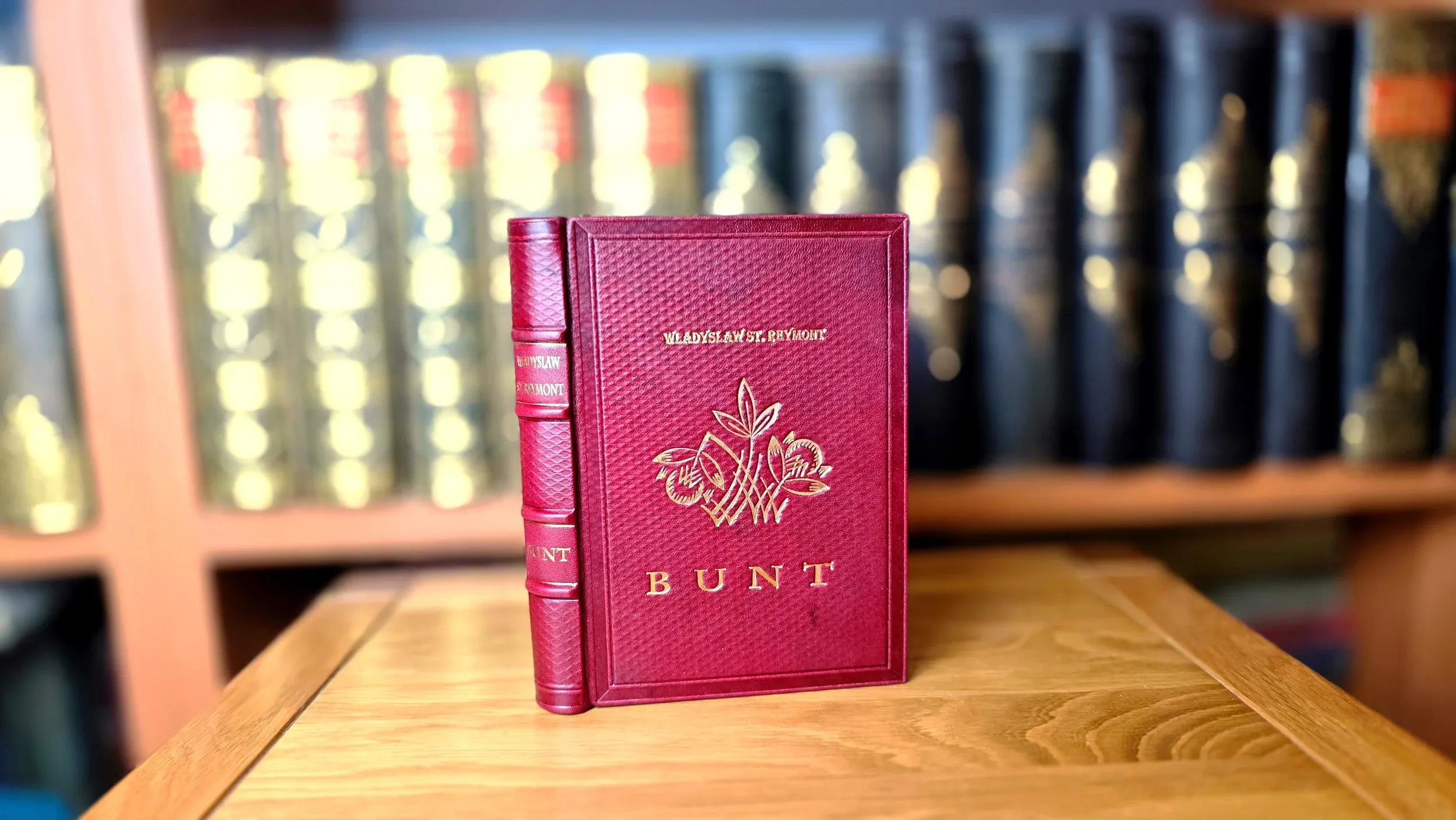
Is “Animal Farm” by Orwell a plagiarism? “Bunt. Basn” by Wladyslaw Reymont (1924) - a forgotten allegory that preceded the classic by over 20 years
The novel “Bunt. Basn” by Wladyslaw Stanislaw Reymont, published in Warsaw in 1924 by Gebethner and Wolff, is one of the most intriguing and at the same time least known works of the Nobel Prize winner. This is the first book edition of the author’s last novel, previously published in serialized form in “Tygodnik Ilustrowany” (1922), which today returns in discussions as a potential literary point of reference for later European political allegories.
Wladyslaw Stanislaw Reymont - Nobel laureate and chronicler of social change
Wladyslaw Reymont
Wladyslaw Reymont (1867–1925) was one of the most important Polish writers of the turn of the 19th and 20th centuries, representing realism and naturalism. His work focused on social transformations, mechanisms of power, and collective life.
His most important works include:
- “Chlopi” - a monumental rural epic, for which he received the Nobel Prize in 1924
- “Ziemia obiecana” - a depiction of early industrial capitalism
- “Komediantka” and “Fermenty” - novels about the artistic environment
The Nobel Prize confirmed his position as one of the most important European writers of his time, and “Chlopi” remains his canonical work.
“Bunt” - an allegory ahead of its time
“Bunt” is a unique work in Reymont’s oeuvre. Written shortly after the Polish-Bolshevik War, it takes the form of a parabolic story about animals rebelling against humans, which quickly becomes a political metaphor.
In interpretative terms, the novel:
- refers to the Russian Revolution
- analyzes mechanisms of ideology and systemic violence
- presents a critical vision of social utopias
Importantly, “Bunt” was published more than 20 years before George Orwell’s “Animal Farm”, which is why literary scholars often compare the two works.
Reymont vs Orwell - inspiration, parallel or independence?
In popular and internet discourse, the question often arises whether Orwell’s “Animal Farm” could have been inspired by Reymont. From an academic perspective, there is no evidence of direct borrowing, but clear thematic parallels exist:
- animals as a metaphor for political systems
- criticism of revolution and its distortions
- mechanisms of power and ideology
- degradation of original ideals
“Bunt” therefore remains a parallel, earlier realization of a similar literary idea, part of a broader European tradition of criticism of totalitarian and revolutionary systems.
Reception and later fate of the work
During the communist period in Poland, the novel was placed on the list of banned books, which further limited its circulation. This was due to its clearly critical attitude toward revolution and collectivist ideologies.
Today, “Bunt” is reinterpreted as:
- a political allegory of the 20th century
- a precursor of literary anti-utopias
- a forgotten part of the Nobel laureate’s legacy
The 1924 edition - first book edition
The presented copy comes from the first book edition (Warsaw 1924, Gebethner and Wolff). The book is in 16°, has 200 pages, and is preserved in its original period half-cloth binding.
Condition:
- minor cover rubbing
- slight traces of dampness
- complete and original edition
Collectible significance and position in our offer
First editions of Wladyslaw Reymont are today highly sought-after antiquarian items, especially less obvious works such as “Bunt”. Our offer includes numerous first editions of the Nobel laureate’s works, including copies:
- in elegant leather bindings
- in bibliophile editions
- and carefully preserved period printings
These are not only first printings, but also copies with high-quality bindings and strong collectible value.
Conclusion
“Bunt” remains one of the most underrated works of Reymont — a novel that, in allegorical form, explores revolution and mechanisms of power, anticipating similar narratives in world literature. Comparisons with Orwell’s “Animal Farm” are not based on evidence of plagiarism, but they highlight how early Reymont explored a literary form that later became a classic of 20th-century literature.
![REYMONT - CHŁOPI t. 1-4 [komplet w 2 wol.]](/media/products/db457eba9b6f3345cffa98108cd73f9a/images/thumbnail/small_wenet20260421-144809.jpg?lm=1776857136)
![REYMONT - CHŁOPI t.1-4 [komplet w 4 wol.] wyd.1; 1904-1906-1909](/media/products/0a86065efefa9777d2b8d5f486b6a446/images/thumbnail/small_batch-20240627-120107.jpg?lm=1765540241)
![REYMONT - ZIEMIA OBIECANA tom I-II [komplet w 2 wol.]](/media/products/14005ebfbc97f65ad5d08abf16ec6476/images/thumbnail/small_wenet20260421-143904.jpg?lm=1776857418)
![REYMONT - CHŁOPI T. 1-2 [komplet] ilustracje KĘDZIERSKIEGO](/media/products/0bc43d0ed16585a1521ee51d9cb88b7b/images/thumbnail/small_collage.png?lm=1765539401)
![REYMONT - DZIEŁA WYBRANE t.1-12 [komplet w 12 wol., kolekcja w skórzanej oprawie]](/media/products/2295fea25314db2ca0f4025fff1abc0e/images/thumbnail/small_batch-20250423-110416.jpg?lm=1765538219)
![SIENKIEWICZ- WIRY t.1-2 [komplet w 2wol.] wyd.1](/media/products/2e92bb7f88ce8b57ddcec65127d511c1/images/thumbnail/small_batch-20220825-130721.jpg?lm=1765538828)


![SIENKIEWICZ - POTOP Tom I-VI [komplet] wyd.2 z 1888 skóra](/media/products/6624b403e36ceb907ef4025e89b1beb0/images/thumbnail/small_20210319-135842.jpg?lm=1765540346)


![ŻEROMSKI - DZIEŁA t.1-23 [komplet w 10 wol.] il. Szancer, Miklaszewski, Henisz, Uniechowski](/media/products/6cf0ef77a3d34d7fdf78cd1aea5e4ae8/images/thumbnail/small_batch-20250218-132113.jpg?lm=1765538219)




 Polish